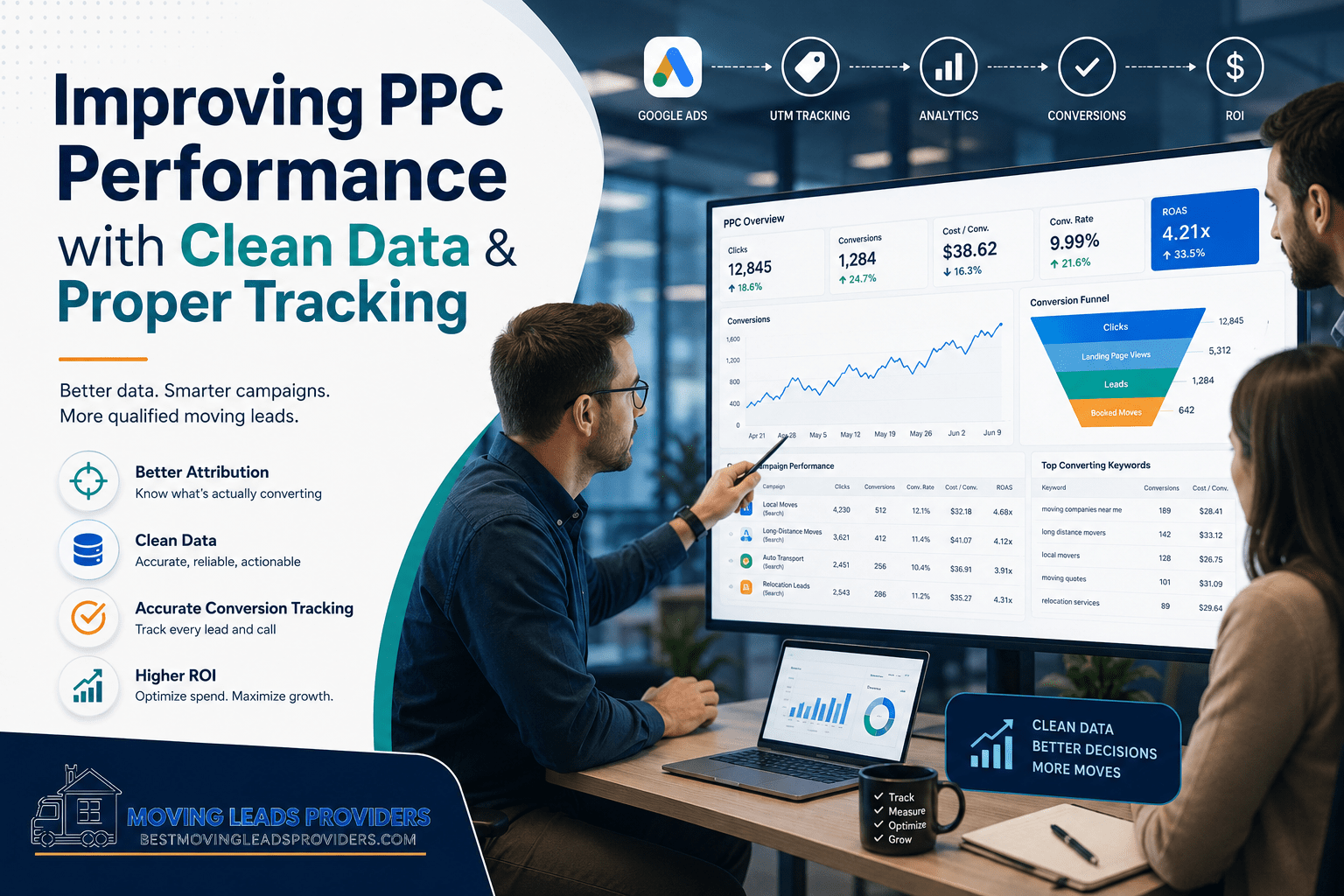
Improving PPC Performance with Clean Data & Proper Tracking
Every moving company running Google Ads or other paid search campaigns eventually hits the same uncomfortable realization: the platform is happy to spend the budget, but the leads coming in tell a different story than the dashboard does. Clicks look strong, conversions appear to be flowing, and yet the phone is not ringing the way the numbers suggest it should. The culprit, almost without exception, is dirty data and broken tracking, and until a moving company solves it, no amount of bid optimization or keyword tweaking will produce the results the ad spend deserves.
At Best Moving Leads Providers, we manage PPC campaigns for movers across the local, long-distance, commercial, and auto transport segments, and the single biggest performance gap we see between top-performing accounts and struggling ones comes down to data hygiene.
The companies that scale their PPC budgets profitably are not the ones with the cleverest ad copy or the largest keyword lists. They are the ones whose conversion data accurately reflects reality, allowing them, and the algorithms behind their campaigns, to make smart, evidence-based bidding decisions. This article breaks down why clean data matters so much, what proper tracking actually looks like, and how movers can build the foundation for PPC campaigns that consistently produce profitable leads.
Why dirty data quietly destroys PPC budgets?
Modern PPC platforms like Google Ads rely heavily on machine learning to optimize bids in real time. The system uses your conversion data to decide who to show your ads to, when to bid more aggressively, and which keywords deserve more spend. The problem is that the algorithm cannot distinguish between a real booked move and a junk form fill. If your account is feeding the system inflated or inaccurate conversion data, it will confidently optimize toward leads that never become customers, and your cost per acquisition will climb while your booked revenue stagnates.
Dirty data in a mover’s PPC account typically comes from a handful of repeat offenders. Duplicate form submissions get counted as separate conversions. Spam leads from low-quality sources trigger conversion events. Phone calls that are actually existing customers or wrong numbers register as new leads. Conversions fire on thank-you pages that people land on by accident. Each one feeds the algorithm a false signal, and over weeks and months those signals compound. The result is a campaign that looks like it is improving while the actual booked job count quietly declines.
For moving companies, this matters more than in most industries because the cost per click in competitive markets can run from several dollars to well over forty dollars depending on the service type and geography. A long-distance moving keyword in a major metro can easily cost twenty-five dollars per click. If your tracking is feeding bad data into the system, you are not just losing efficiency, you are burning real money on bids that the algorithm thinks are working.
What Proper Conversion Tracking Looks Like for Movers
Accurate tracking starts with defining what a true conversion actually is for your business. For most moving companies, a conversion is not a form fill or a phone call. It is a qualified lead, someone who matches your service area, fits your service type, and has a genuine intent to book. The closer your tracking moves toward measuring this real-world definition, the more useful your data becomes.
Call tracking with dynamic number insertion
The first layer is call tracking with dynamic number insertion. Phone calls remain the dominant conversion channel for movers, especially for long-distance and commercial inquiries where customers want to speak with a human before committing.
Without dynamic number insertion, you cannot tie a phone call back to the specific keyword, campaign, or ad that produced it. With it, you suddenly see which campaigns drive actual booking conversations versus which ones drive curiosity calls that never convert. Call tracking also lets you filter out short calls, repeat callers, and after-hours voicemails that should not count as leads.
Proper form tracking with validation
The second layer is proper form tracking with validation. A submission only deserves to be counted as a conversion if it represents a real prospect. Honeypot fields, basic validation rules, and integration with your CRM allow you to filter out bot submissions and duplicate entries before they pollute your conversion data. Many movers we work with discover, once validation is in place, that twenty to forty percent of what they thought were leads were never real to begin with.
CRM and offline conversion import
The third layer is CRM and offline conversion import. The most powerful upgrade any mover can make to their PPC tracking is sending qualified lead and booked job data back into Google Ads as offline conversions. When the algorithm learns not just that a form was filled, but that the lead became a quoted estimate or a booked move, it begins optimizing toward your actual revenue rather than toward surface-level activity. This single change has transformed PPC performance for many of the moving companies we support.

Cleaning up the lead data you already have
Before you can trust new data, you usually need to clean up the data sitting in your CRM. Most moving companies have years of records that contain duplicates, mislabeled leads, incorrect service categories, and prospects whose final outcome was never recorded. When this messy history is used to evaluate PPC performance, the conclusions drawn from it are unreliable.
Start by establishing a simple lead status taxonomy that everyone on your sales team uses consistently. A lead might be new, contacted, quoted, booked, lost, or disqualified. When every lead gets tagged accurately, you can finally answer the questions that matter: which campaigns produce booked moves, which produce only quotes, and which produce noise. Without this discipline, even the most sophisticated tracking setup eventually drifts into chaos.
Deduplication is the next priority. The same customer often submits multiple forms across different platforms, calls in after submitting online, or appears under slightly different name spellings. Without deduplication rules, each touchpoint inflates your conversion count and skews your attribution. Most CRMs offer basic deduplication tools, and the cleanup pays for itself within a single ad cycle.
Finally, audit your sources. Every lead in your CRM should have a clear origin — Google Ads, organic search, a specific lead provider, referral, repeat customer. When the source field is empty or inconsistent, you cannot evaluate which channels deserve more budget. This is one of the most common gaps we fix when we onboard movers into our PPC for movers services, and the visibility it creates is often the first time the business owner truly understands where their best customers come from.
How Clean Data Transforms Bidding Decisions
Once tracking is accurate and data is clean, bidding strategy becomes a different conversation. Instead of guessing whether a campaign is profitable, you can see exactly which keywords, ad groups, and audiences produce booked revenue. You can confidently raise bids on the terms that drive real jobs and pause the ones that produce only inflated conversion counts. Smart bidding strategies like Target ROAS and Maximize Conversions finally work the way Google promises, because they are now being trained on signals that reflect business reality.
Movers who reach this stage typically see meaningful drops in cost per acquisition within the first sixty to ninety days. More importantly, they unlock the ability to scale their ad spend without watching their margins collapse. Clean data does not just make existing budgets work harder — it makes growth budgets viable in the first place.
This is the work our team at Best Moving Leads Providers does for moving companies across the country. Alongside the exclusive, shared, and live transfer leads we deliver, our PPC management, SEO services, and reporting tools are built around the principle that no ad budget should be spent on data you cannot trust.

Bottom Line
PPC success for moving companies is not won at the bid level. It is won at the data level. The movers who invest in clean tracking and disciplined lead management consistently outperform those who chase clever campaign tactics on top of broken foundations. If you are ready to build a PPC engine that actually reflects your business and scales profitably, Best Moving Leads Providers is here to help you put the right tracking, the right leads, and the right strategy in place.