Connecting CRM & Marketing Platforms for Full-Funnel Tracking
Most moving companies invest heavily in marketing channels including, paid search, SEO, social ads, lead purchases, email outreach, SMS follow-ups, but very few can answer a simple question with confidence: which channel actually produced our last ten booked moves? The answer almost always lives somewhere between the marketing platforms generating the leads and the CRM tracking the sales conversations. When those two worlds are disconnected, decisions get made on gut feel, budgets get allocated based on surface-level metrics, and the most profitable opportunities slip through the cracks unnoticed.
At Best Moving Leads Providers, we work with moving companies of every size. And the difference between those who scale predictably and those who plateau almost always comes down to one factor: whether their CRM and marketing platforms are connected. Full-funnel tracking, which is the ability to follow a customer from first click to booked job to repeat referral, is no longer something reserved for enterprise movers. It is the foundation of profitable growth in a competitive industry. This article explains why integration matters, what a connected system actually looks like, and how moving companies can build one without overhauling their entire tech stack.

The Cost of Disconnected Systems for Moving Companies
When marketing platforms and CRMs operate in isolation, the moving company essentially runs two parallel businesses that never talk to each other. The marketing side sees clicks, form fills, and call counts. The sales side sees quotes, conversations, and booked jobs. Neither side can answer the questions that actually matter for growth, because the data required to answer them lives on both platforms at once.
The practical consequences show up everywhere. A moving company may be spending heavily on Google Ads for long-distance keywords without realizing that those clicks produce mostly tire-kicker quotes that never book. Meanwhile, their organic SEO traffic might be quietly delivering the highest-converting jobs, but with no clear attribution, the SEO budget gets cut first when cash is tight. A batch of leads purchased from one provider may look expensive on paper but produce twice the booked revenue of a cheaper alternative — except the company never connects the dots because the booked revenue lives in the CRM while the lead source lives in a spreadsheet nobody updates.
These are not edge cases. They are the daily reality for most movers operating without integrated systems, and they are the reason so many marketing budgets feel like they are working harder than ever while producing diminishing returns.
What Full-Funnel Tracking Actually Means
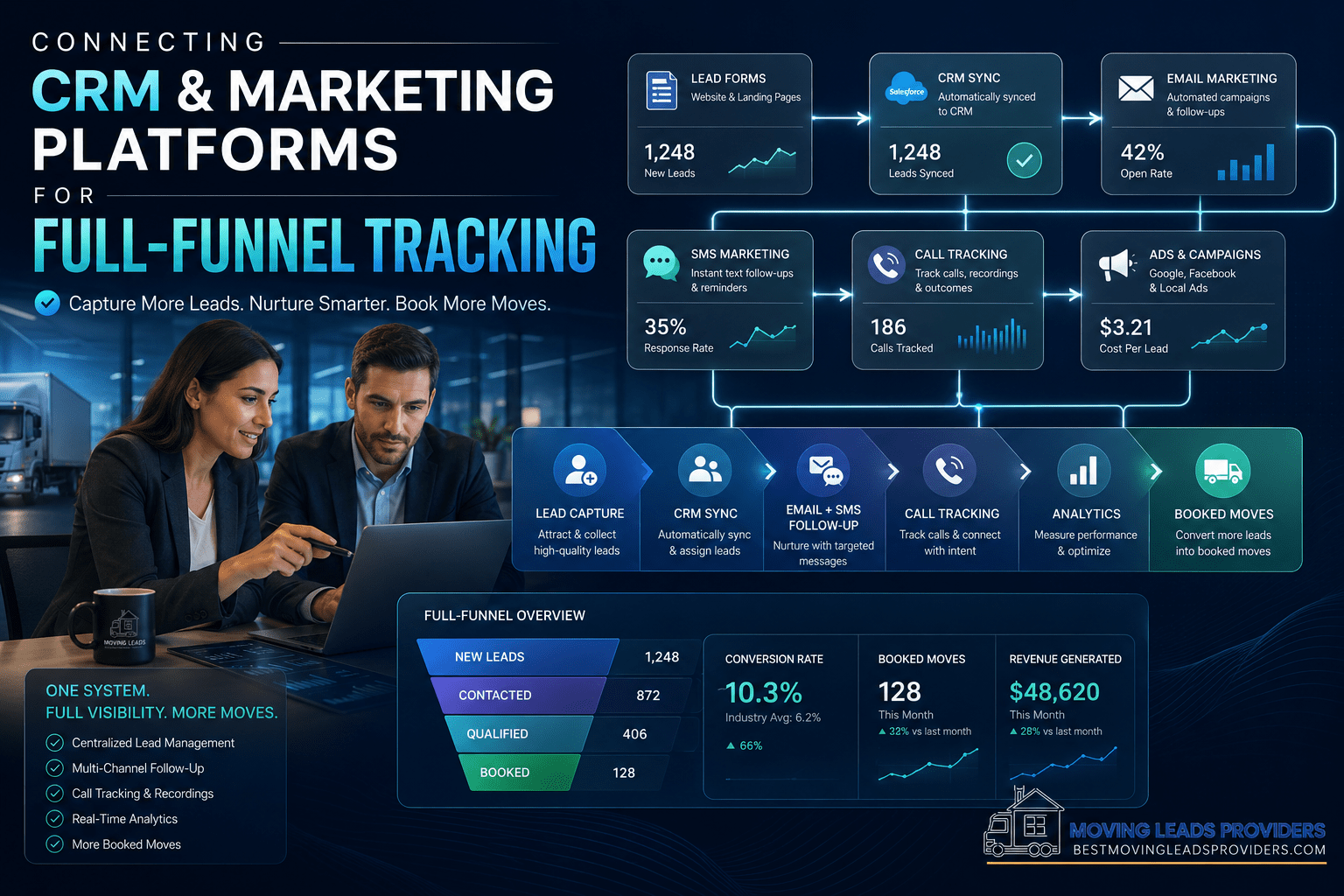
Full-funnel tracking is the ability to trace a single customer journey from the moment they first interact with your brand to the moment they pay the final invoice — and ideally, beyond, into repeat business and referrals. For a moving company, that journey typically includes several distinct stages, each of which generates data that should connect back to a single customer record.
First Touch
The journey begins with first touch, which might be a Google search, a click on a Facebook ad, a referral from a partner site, or a form submission on a lead provider’s platform. The data here belongs to your marketing platforms — Google Ads, Meta, SEO tools, lead provider dashboards. At this stage, the customer is anonymous in any meaningful sense, but every detail about how they arrived matters for later analysis.
Engagment Stage
The journey continues with engagement, where the customer fills out a quote form, requests a callback, accepts a live transfer, or replies to an SMS. This is where the marketing platform hands the customer over to the CRM. If that handoff is clean — meaning the source, campaign, keyword, and timestamp all transfer along with the lead — your CRM now holds a record rich enough to drive real decisions later. If the handoff is messy or incomplete, you have a lead with a name and a phone number but no story behind it.
Qualifying Lead
The journey then moves into qualification and quoting, where your sales team determines whether the lead is real, fits your service area, and matches your service type. This is purely CRM territory, but the labels applied here — qualified, quoted, disqualified — need to flow back to the marketing platforms so they can learn which sources produce the leads worth pursuing.
Closing
Finally, the journey closes with booking, completion, and repeat or referral activity. The revenue generated by a customer should be tied back to the original source. When a long-distance move worth several thousand dollars closes, both your CRM and your ad platform should know which campaign earned that revenue. Without this loop, growth investments are essentially educated guesses.

How the Right Integrations Change Everything
When CRMs and marketing platforms are connected properly, the business gains visibility that fundamentally changes how decisions get made. Suddenly, the moving company can see that a specific Google Ads keyword produces leads that book at twice the rate of the account average. They can see that leads from one provider close faster than leads from another, even though the per-lead cost is similar. They can see that SMS follow-ups within fifteen minutes recover thirty percent more cold leads than follow-ups sent the next morning. None of these insights are possible without integrated data, and all of them translate directly into smarter budget allocation.
Capturing Details
The technical foundation of this integration typically rests on three pillars. The first is a CRM that captures source attribution by default, meaning every lead that enters the system arrives with a clear record of where it came from — the campaign, the keyword, the ad group, the lead provider, or the referral source.
Sync with Marketing Platforms
The second is bidirectional sync with marketing platforms, where qualified leads, quoted estimates, and booked jobs flow back into Google Ads, Meta, and other systems as offline conversions. This is what allows the algorithms behind your ad campaigns to learn from real business outcomes rather than from surface-level form fills.
Integrated Reporting
The third is a single source of truth for reporting, usually a dashboard or business intelligence layer that pulls data from both the CRM and the marketing platforms into one place where the moving company owner can see everything that matters in a single view.
Movers who reach this level of integration stop guessing. They know which channels deserve more budget, which campaigns to pause, which lead sources to scale up, and which sales team members are best at converting which types of leads. The compounding effect of these decisions over time is what separates a moving company that doubles in revenue from one that stays flat.
Practical Steps to Connect Your Systems
Building integrated tracking does not require an enterprise-level technology overhaul. Most moving companies can make meaningful progress in a matter of weeks by focusing on the right foundations.
Step 1- Auditing
Begin by auditing how leads currently enter your CRM. If they arrive without source tags, this is the first gap to close. UTM parameters on your ads, hidden form fields that capture campaign data, and integrations between your lead providers and your CRM should all be configured so that every new record arrives with its origin clearly stamped. When you purchase leads from providers like Best Moving Leads Providers, those leads can be delivered directly into your CRM with full source attribution, removing manual data entry and the errors that come with it.
Step 2- Define Lead Stages
Next, define your lead lifecycle stages clearly. A lead should pass through consistent statuses — new, contacted, qualified, quoted, booked, completed, lost — that every team member uses the same way. This is less a technology problem and more a discipline problem, but the payoff is enormous because it makes every downstream metric trustworthy.
Step 3- Setting Up Offline Conversions Imports
Then, set up offline conversion imports back into your major ad platforms. Google Ads, Meta, and other platforms all support this, and the configuration is usually a one-time setup that runs automatically thereafter. Once active, your campaigns will gradually shift toward producing the kinds of leads that actually book moves, not just the ones that fill out forms.
Step 4- Building a Reporting Dashboard
Finally, build or commission a reporting dashboard that combines marketing spend, lead volume, conversion rates, and revenue by source. The visibility this creates often reveals immediate opportunities — campaigns to scale, sources to drop, follow-up gaps to fix — that pay for the entire integration effort within a single quarter.
This is exactly the work our team at Best Moving Leads Providers supports through our digital marketing services, including PPC management, SEO, online reputation management, and the delivery of high-quality exclusive, shared, and live transfer moving leads that integrate cleanly into the systems movers already use.

Final Word
A connected CRM and marketing stack is the difference between running a moving company on instinct and running one on insight. The movers who invest in full-funnel tracking consistently outperform their competitors because every decision they make is backed by real data, not assumptions. If you are ready to build a growth engine that turns marketing spend into measurable, profitable bookings, Best Moving Leads Providers is here to help you connect the pieces.