Crafting High-Converting PPC Ads for Moving Services
Pay-per-click advertising can be one of the fastest ways to fill a moving calendar—but only when it’s built for how people actually choose movers. Too many campaigns fail because the ads are generic, the targeting is too broad, and the follow-up process is slow. In competitive markets, PPC isn’t about “getting clicks.” It’s about earning the call, capturing the lead, and converting the booking before a competitor does.
At Best Moving Leads Providers, we work with moving companies that rely on paid acquisition to keep trucks moving year-round. The movers who consistently win aren’t necessarily the ones spending the most. They’re the ones who tighten intent, sharpen messaging, and align the ad, landing page, and sales process into one cohesive system. Here’s how to build PPC ads that convert at a higher rate and bring down your cost per booked move.
Start With the Most Important PPC Truth for Movers
Most customers don’t want to “browse movers.” They want to solve a problem. They are stressed, time-constrained, and risk-averse. Your PPC ad must do three things fast:
- Confirm you serve their area and move type
- Reduce perceived risk (professional, careful, reliable)
- Give them a clear next step (call, quote, availability check)
If your ad copy doesn’t immediately signal those three points, you’ll pay for clicks that never turn into estimates.

Build Campaigns Around Intent, Not Just Cities
A high-converting PPC structure separates campaigns by what the searcher is trying to do. For movers, that usually means:
Local moving intent
Keywords like “local movers,” “movers near me,” “[city] moving company,” “apartment movers [city].”
These searchers typically want a quote quickly and are comparing options.
Long-distance or interstate intent
Keywords like “long distance movers,” “interstate moving company,” “moving from [city] to [city].”
These leads are often higher value but require stronger trust signals and a clearer process.
Service add-ons and specialty intent
Keywords like “packing services,” “labor only movers,” “piano movers,” “moving and storage.”
These terms can convert extremely well when you have dedicated landing pages.
When you mix all intents into one campaign, your ad copy becomes vague and your landing page becomes a compromise. Segmentation lets you write ads that match exactly what the customer searched, and that’s how conversion rates rise.
Keyword Strategy: Protect Your Budget Before You Write Copy
Most moving PPC waste happens at the keyword level. The goal is not volume. It’s qualified demand.
Focus on high-intent keyword patterns
- “movers near me”
- “[city] movers”
- “moving company [city]”
- “apartment movers [city]”
- “local moving services [city]”
- “long distance movers [origin]”
- “moving from [origin] to [destination]”
These searches are usually closer to booking.
Use match types intentionally
Exact and phrase match keep targeting tighter. Broad match can work, but only with strong negative keyword lists and enough conversion data to guide the algorithm. If you’re newer to PPC or operating on a tighter budget, start controlled.
Negatives are non-negotiable
A strong negative list protects your cost per lead. Common negatives for movers include:
“jobs,” “employment,” “salary,” “free,” “uhaul,” “rental,” “boxes free,” “how to,” “DIY,” “definition,” “cheap” (optional), and irrelevant service terms you don’t offer.
The better your negative list, the more your ads show to people who actually intend to hire movers.

Ad Copy That Converts: How Movers Should Write PPC Ads
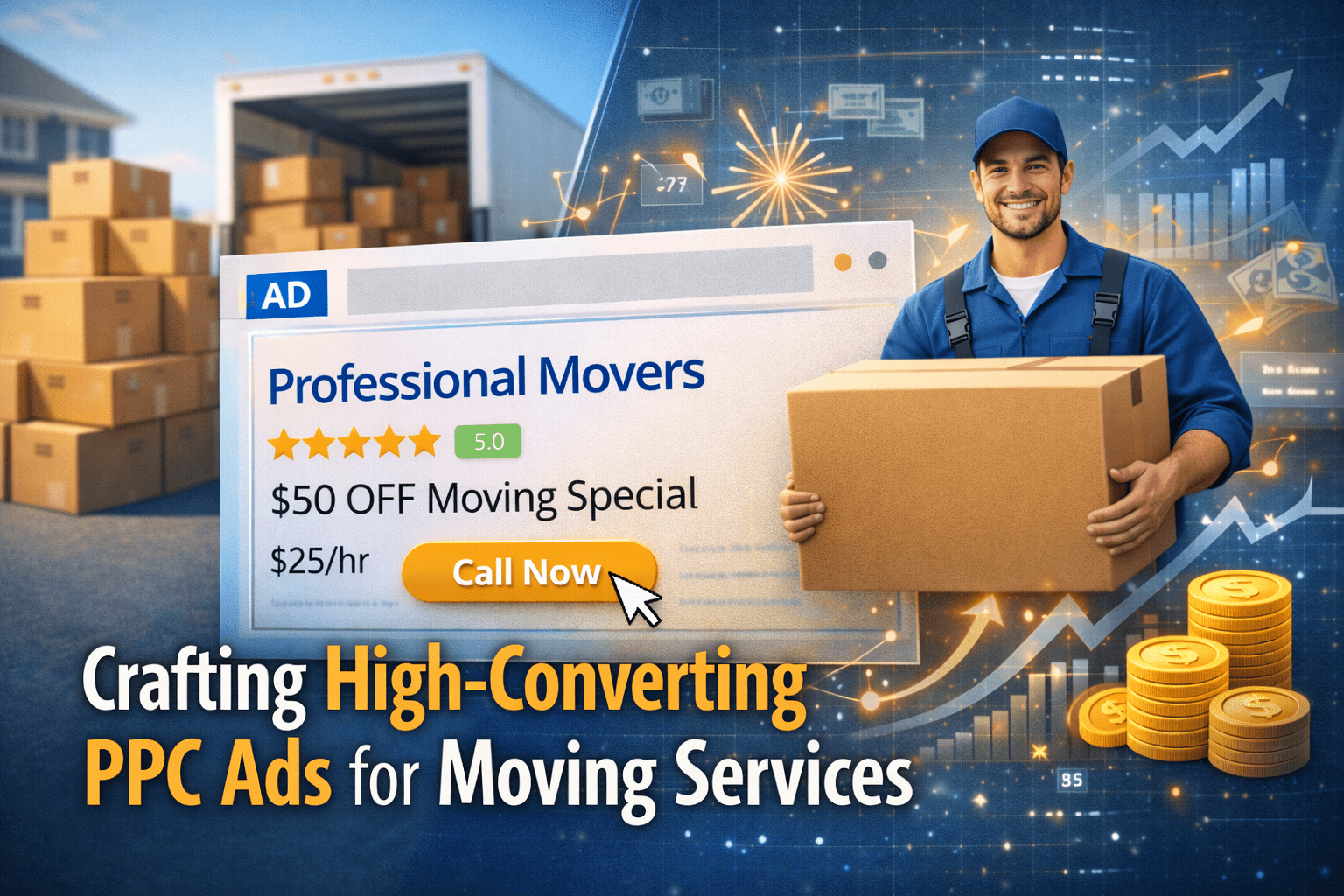
The best moving ads are simple, specific, and confidence-building. You’re not trying to be clever. You’re trying to be trusted.
Use a “local + service + proof” formula
A reliable structure is:
Local relevance: “Trusted [City] Movers”
Service clarity: “Local & Long-Distance Moving + Packing”
Proof or reassurance: “Licensed/Insured (if true), 5-Star Reviews, Careful Crews”
Action: “Get a Fast Quote Today”
Your audience is anxious. They want a mover who looks organized.
Mention the pain points customers actually worry about
High-converting copy addresses concerns without sounding defensive:
- “Upfront pricing and clear minimums”
- “Furniture protection included”
- “On-time arrival windows”
- “Clean trucks, trained crews”
- “Apartment, condo, and house moves”
If you protect floors, wrap furniture, and communicate well, say it. Those details differentiate you more than “affordable” ever will.
Use offer language carefully
Offers can work—especially in competitive suburbs—but only if they’re believable and operationally realistic. Instead of huge discounts, consider:
- “Free quote in minutes”
- “Same-week availability” (only if true)
- “Packing supplies available”
- “No-surprise estimates”
- “Weekend moves available”
In moving, trust beats gimmicks.
Write sitelinks and callouts that pre-qualify
Your ad extensions can do heavy lifting:
- Sitelinks: “Apartment Moving,” “Packing Services,” “Long-Distance,” “Pricing & Policies”
- Callouts: “Background-Checked Crews” (only if true), “Furniture Wrapped,” “Floor Protection”
- Structured snippets: “Services: Local, Long-Distance, Packing, Storage”
Extensions increase your ad footprint and filter clicks toward the right customers.
Landing Pages: Where Most Moving PPC Campaigns Break
You can write the best ad in the market and still lose money if the landing page is weak. PPC landing pages must be built for urgency and trust.
Match the page to the keyword
If someone clicks “apartment movers [city],” don’t send them to a generic homepage. Send them to an apartment-moving landing page that speaks to:
- stairs and elevators
- COI requirements
- parking and move windows
- protection for walls and floors
Message match improves conversion and lowers wasted spend.
Put proof above the fold
Your top screen should include:
- Clear headline: “Professional Movers in [City]”
- One-sentence reassurance: “Trained crews, careful protection, fast quotes.”
- Strong CTA: “Request a Quote” + click-to-call button
- Reviews/testimonials snippet and rating context (where accurate)
- Real photos of your team/trucks
Reduce friction in the quote form
Long forms kill conversions. Ask for what you need to follow up:
- Name
- Phone
- Move date range
- Move size (dropdown)
- Pickup zip code
You can gather details later. The goal is to start the conversation.
Conversion Isn’t Just the Ad—It’s Speed-to-Lead
Moving leads go cold fast. Many prospects contact 3–5 movers within minutes. A high-converting PPC campaign requires a response process built to win that race.
High-performing movers typically:
- Call within 5 minutes of a form submission
- Text immediately with a short, friendly confirmation
- Offer two fast options: phone quote now or scheduled estimate
- Follow up multiple times over 24–48 hours (without being aggressive)
If you can’t respond quickly, your cost per booked job will stay high no matter how good your ads are.
Smart Budget Allocation for Movers
Instead of spreading budget evenly, allocate based on profitability and operational capacity:
- Heavier budget on your best-margin move types (often local residential, certain long-distance lanes, packing add-ons)
- Reduce spend in unprofitable radii where drive time kills margins
- Increase bids during high-converting windows (end-of-month, weekends) if you can staff accordingly
PPC should follow your operations. If your crews are booked solid on Saturdays, don’t pay premium bids for Saturday queries unless you’re willing to add capacity or steer demand to other days.

How Best Moving Leads Providers Helps PPC Convert Better
A lot of movers try PPC because they need leads fast—but they struggle with inconsistent quality or high costs. One way to stabilize growth is to pair PPC with a consistent inbound pipeline and stronger conversion systems.
Best Moving Leads Providers supports movers with exclusive and shared moving leads and marketing guidance that helps improve close rates: better scripts, better follow-up timing, and better funnel strategy. When your PPC campaigns bring in demand and your lead program smooths out gaps, your business becomes less vulnerable to seasonal swings and ad volatility.
Conclusion: Build PPC Like a Booking System, Not a Click System
High-converting PPC for moving services is not about catchy headlines or massive budgets. It’s about building a system where every piece supports the next: tightly matched keywords, trust-building ad copy, landing pages that convert, and fast follow-up that closes.
If you want PPC that actually produces booked jobs, treat it like operations. Control intent, sharpen your message, and respond like your next truck depends on it—because in peak season, it does.