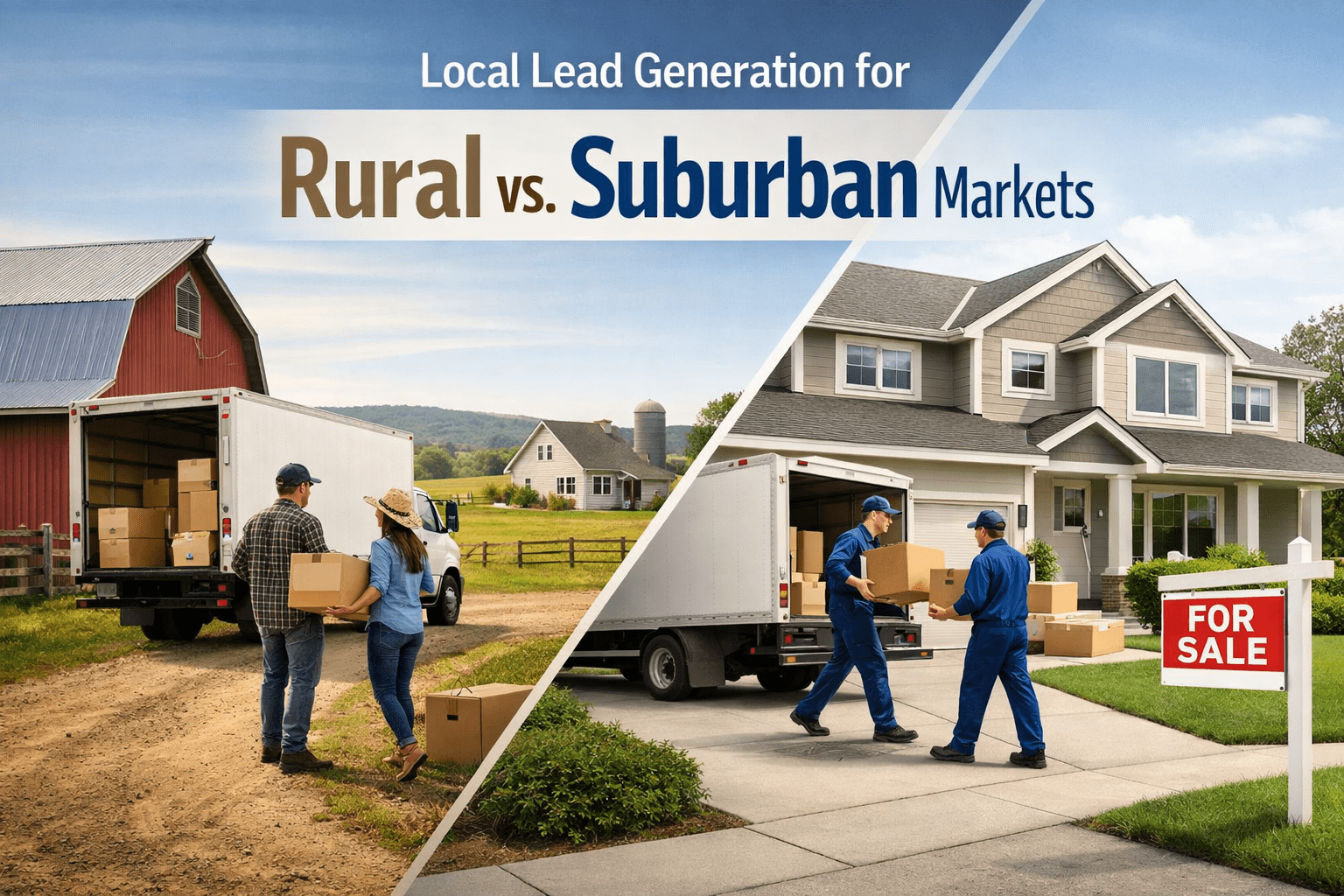
Local Lead Generation for Rural vs. Suburban Markets
Local lead generation isn’t one-size-fits-all in the moving industry. A company trying to win jobs in a sparsely populated rural county faces an entirely different reality than a mover competing in a busy suburban corridor packed with new construction, apartment communities, and constant turnover. Both markets can be profitable, but the way you attract, qualify, and convert leads needs to match local behavior, geography, and competition.
At Best Moving Leads Providers, we talk to movers across every type of market, from small-town operators covering multiple counties to suburban teams running tight service zones with multiple trucks. What we see repeatedly is this: rural movers win by building trust and visibility where people actually gather, while suburban movers win by speed, proof, and precision targeting. Below is a practical comparison of strategies for both, including offline tactics that still outperform in the right place.

Rural vs. Suburban Lead Generation: What’s Really Different?
Before you choose tactics, you need to understand what you’re up against.
Rural markets: fewer searches, longer relationships
Rural areas often have lower search volume for “movers near me,” fewer competitors, and customers who may prefer recommendations over ads. The upside is that a strong reputation can dominate quickly. The challenge is that the lead pool is smaller and more spread out, jobs may be farther apart, and marketing must cover a wider service radius without wasting spend.
Suburban markets: high demand, high competition, fast decisions
Suburbs generate more moving activity: families upgrading homes, renters moving between complexes, and people relocating for schools and commute convenience. The lead volume is higher, but so is the noise. Prospects compare multiple companies quickly, read reviews, and often choose based on availability and perceived professionalism. Speed-to-lead and strong proof (reviews, photos, credentials, clear pricing policies) matter a lot.
The Rural Playbook: Trust, Community, and Coverage
In rural markets, your lead generation is often less about chasing clicks and more about becoming the mover people “already know.”
Build a locally dominant Google Business Profile
Even if search volume is lower, rural leads tend to be high-intent. Make sure your Google Business Profile is complete: service areas (multiple towns/county names), categories (moving company, storage if applicable), photos of your crew/trucks, and frequent updates. Rural customers often want reassurance that you’re real and nearby.
The big rural advantage is review velocity. If you consistently ask every customer for a review, you can become the obvious choice in a market with few movers actively managing reputation. Add review requests into your job closeout process: text message, email, and a simple card handed to the customer.
Target the “town name” keywords on your website
Rural SEO isn’t about ranking for one city, it’s about ranking for many small places. Create a clean structure of service pages for your coverage area: “Movers in [Town],” “Moving Services in Sacramento County,” and “Long-Distance Moving from United States.” Keep the content real: local landmarks, your typical routes, and the kinds of moves you handle.
Use partnerships as lead engines
Rural markets run on relationships. A handful of strategic partners can drive a steady stream of referrals:
- Local real estate agents and brokerages
- Storage facilities and small self-storage owners
- Property managers for scattered rentals
- Local banks and credit unions that sponsor community events
- Contractors, HVAC, and cleaning companies that already get “moving” questions
The key is consistency. A one-time handshake won’t produce predictable leads. Drop off co-branded flyers quarterly, send a quick update when your schedule opens up, and refer work back whenever you can.
Offline tactics that still win in rural areas
Offline is not “old school” in rural markets, it’s often the main channel.
Community event presence: County fairs, high school sports, local parades, charity runs, these are high-visibility moments with trust built in. Sponsoring a small banner or providing a “moving tips” handout can put your name in front of the exact families who move locally.
Local bulletin boards and print: Feed stores, diners, libraries, post offices, and community centers still have foot traffic. A simple, clean flyer with a strong offer (seasonal discount, senior move special, or free quote with guaranteed callback) can outperform low-volume digital ads.
Direct outreach to real estate offices: Drop off a “closing day move kit” pack: a brochure, fridge magnet, and a referral card with a modest incentive for the agent (or a customer perk). Agents in rural markets often work fewer transactions but rely heavily on trusted vendors.

Rural pricing and service-zone messaging
Rural prospects worry about travel fees and availability. Your marketing should clarify:
- Your service radius and how you price distance
- Whether you do same-day or weekend moves
- What “minimum hours” means, if you have one
- Transparent policies for long drive times
When rural customers feel surprised by fees, referrals dry up. Clarity helps you keep community trust.
The Suburban Playbook: Speed, Proof, and Precision Targeting
In suburban markets, you’re competing in a crowded auction for attention, online and offline. The movers who win most consistently are the ones who respond fastest, look most credible, and keep their targeting tight.
Win the “near me” battle with reviews + content + photos
Suburban customers scroll. A lot. Your Google profile needs strong review volume, high star rating, and photos that show professionalism: wrapped furniture, clean trucks, uniformed crew, and before/after shots of staged rooms or protected floors. Add short posts weekly, availability updates, moving tips, seasonal checklists, because activity signals legitimacy.
Tighten your service areas and build suburb-specific pages
Suburban marketing works best when you’re not trying to be everywhere. Choose a manageable set of suburbs and dominate them. Build pages for each with content tailored to that area: neighborhoods, housing types (split-levels, townhomes, apartments), common access issues (stairs, narrow driveways), and what your team does to protect floors and walls.
Paid ads: win with intent and speed-to-lead
Suburban PPC and Local Services Ads can be powerful, but only if your follow-up is immediate. In competitive suburbs, leads often go to the first mover who answers and sounds organized. That’s why the ad strategy and the sales process must work together: call tracking, fast quoting, and a clear script that builds confidence.
This is also where working with a lead partner like Best Moving Leads Providers can tighten your pipeline. When you’re buying leads, exclusive or shared, what matters is matching lead type to your capacity and market conditions, then running a disciplined response process to convert more of the leads you pay for.

Suburban offline tactics: targeted, not broad
Offline can work in suburbs too, but random flyers won’t cut it. You need targeted placements where movers are top-of-mind.
Apartment and HOA relationships: Suburban moves cluster around apartment turnovers, townhome communities, and HOA neighborhoods. Build relationships with leasing offices, concierge desks, and HOA managers. Provide move-day protection materials (floor runners), a certificate of insurance packet, and a clear process for elevator reservations and parking. Being the “easy mover” for management can create recurring leads.
New construction and builder partnerships: Suburbs often have constant development. Builders, design centers, and flooring companies are asked about movers regularly. A simple partnership with consistent collateral and a professional introduction can yield steady referrals.
Door hangers after “for sale” signs go up: Timing matters. If you track local “just listed” activity, door hangers with a helpful checklist and a direct quote link can convert. Keep the message about planning and stress reduction, not gimmicks.
The Biggest Mistake Movers Make in Both Markets
The mistake isn’t choosing the “wrong” tactic. It’s using the same strategy everywhere.
- Rural movers often waste money on broad digital ads without building local trust channels.
- Suburban movers often rely on word-of-mouth alone and get drowned out by competitors who have stronger online proof and faster follow-up.
Your market determines which lever matters most: trust and community visibility in rural areas, versus speed and credibility signals in suburbs.
How to Decide Your Strategy Mix
If you’re rural, prioritize:
- Reputation building (reviews, relationships, community presence)
- Multi-town SEO coverage
- Partnerships that create recurring referrals
- Clear distance/pricing messaging
If you’re suburban, prioritize:
- Google profile dominance and fast review generation
- Tight geographic targeting with suburb-specific pages
- Paid lead flow paired with rapid response systems
- Offline partnerships with apartments/HOAs/builders
And in either market, consistency beats intensity. A steady monthly routine—reviews, outreach, content updates, follow-up discipline—creates a compounding pipeline.

Final Word: Match the Method to the Market
Rural and suburban markets can both produce excellent local moving leads, but they reward different behaviors. Rural markets respond to familiarity, reputation, and community presence. Suburban markets reward speed, proof, and precise targeting. If you align your lead generation system to your local realities, and back it with a reliable stream of qualified opportunities, you’ll spend less time chasing and more time booking.
If you want to stabilize your pipeline with exclusive or shared moving leads and strengthen your marketing foundation to convert more calls into booked jobs, Best Moving Leads Providers can help you build a strategy tailored to your exact market conditions.
FAQs
Referrals and local partnerships are usually the most reliable, supported by a strong Google Business Profile and multi-town SEO to capture high-intent searches.
Yes. In rural markets they often outperform digital due to tight-knit communities. In suburbs, offline works best when targeted—apartments, HOAs, and new construction networks.
Ideally both. SEO builds long-term stability, while ads and lead programs can fill the calendar quickly. The deciding factor is whether you can respond fast enough to convert paid leads.
Tighten targeting to your core service zone, focus on high-intent keywords, and prioritize reputation/partnership strategies that don’t depend on volume.
Improve speed-to-lead (answer within minutes), strengthen your proof (reviews, photos, clear policies), and streamline quoting so prospects feel confident booking immediately.