Setting Up CRM Workflows for Commercial Moving Projects
Commercial moving projects are a different game entirely. Unlike residential moves, they rarely involve a single decision-maker, a simple timeline, or a straightforward scope of work. Instead, you’re dealing with office managers, procurement teams, executives, IT coordinators, and sometimes even third-party consultants, all influencing the outcome.
Without a structured system, these projects quickly become chaotic. Emails get lost, follow-ups slip, timelines shift, and opportunities fall through the cracks. That’s why a well-designed CRM workflow is not just helpful, it is essential.
For moving companies aiming to win and manage high-value commercial contracts, your CRM should function as a command center. It should organize communication, track decision-makers, manage timelines, and guide your team through every stage of the deal.
At Best Moving Leads Providers, this is where operational efficiency meets lead generation. Getting commercial moving leads is one thing, converting and managing them properly is what drives real growth.
Why Commercial Moving Requires a Different CRM Approach
A residential lead might involve one or two conversations before closing. A commercial project can involve weeks, or even months, of coordination.
You are not just selling a move. You are selling planning, logistics, risk management, and execution.
This complexity introduces several challenges:
- Multiple stakeholders with different priorities
- Longer sales cycles and approval processes
- Detailed site surveys and custom quotes
- Phased or multi-location move timelines
- Higher expectations for communication and reporting
A generic CRM setup designed for quick residential jobs will not support this level of detail. Commercial workflows must be more structured, more collaborative, and more transparent.

Designing a Multi-Stage Pipeline That Reflects Reality
The first step in building an effective CRM workflow is creating a pipeline that mirrors how commercial deals actually progress.
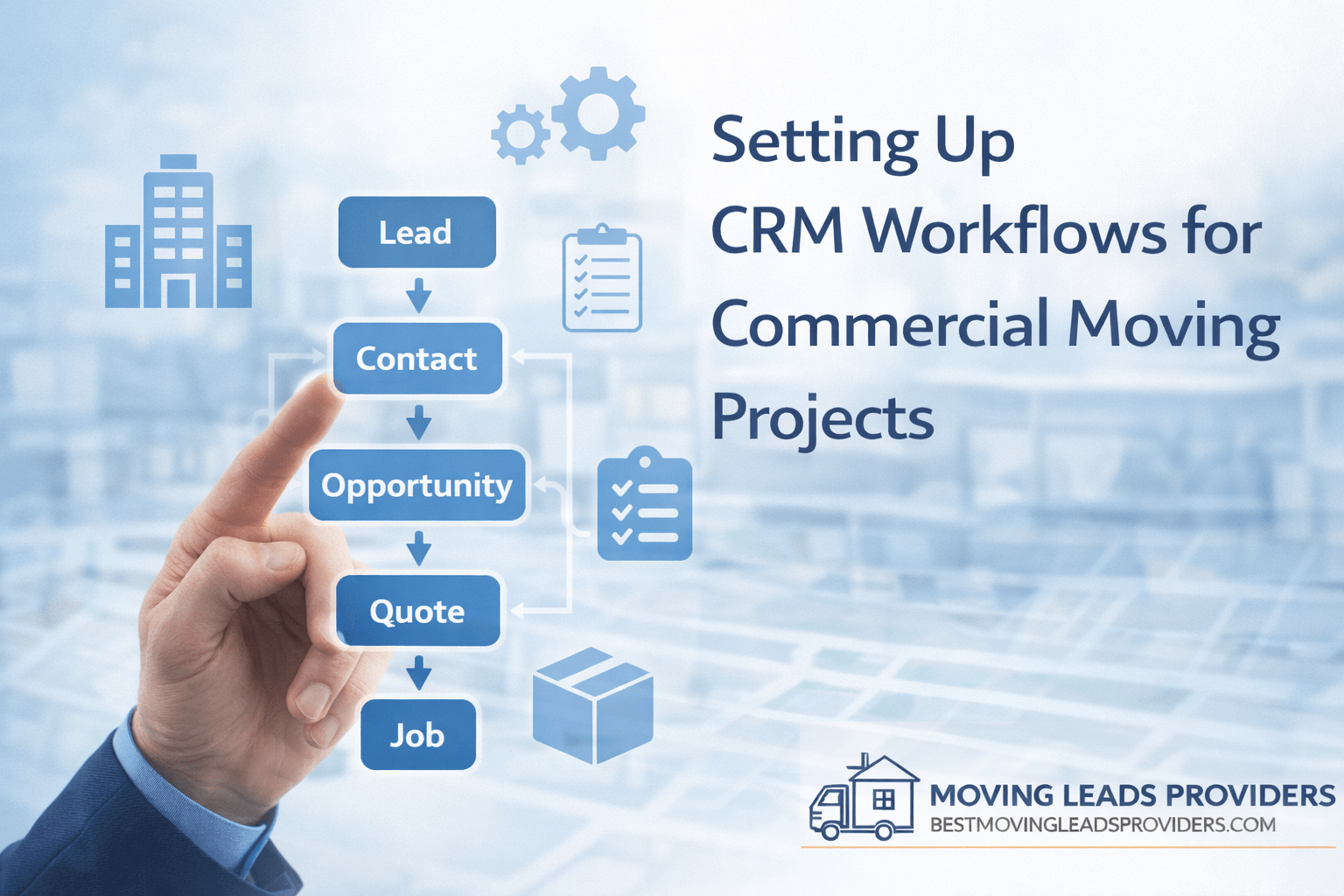
Instead of a simple “lead → quote → booked” flow, commercial pipelines should include multiple stages that reflect both sales and operational milestones.
Example Pipeline Structure
A well-designed commercial moving pipeline might include:
- Initial Inquiry / Lead Capture
- Qualification & Needs Assessment
- Site Survey Scheduled
- Site Survey Completed
- Proposal Development
- Proposal Submitted
- Stakeholder Review & Negotiation
- Contract Signed
- Pre-Move Planning
- Move Execution
- Post-Move Follow-Up
Each stage should trigger specific actions inside your CRM—tasks, reminders, document uploads, or internal notifications.
This structure ensures that nothing is skipped and every team member understands where the project stands.
Managing Multiple Decision-Makers Without Losing Control
One of the biggest challenges in commercial moving is tracking who is involved in the decision.
A single project might include:
- A facilities manager coordinating logistics
- A finance team approving budgets
- An executive sponsor making final decisions
- An IT lead managing equipment relocation
Your CRM should allow you to attach multiple contacts to a single deal, each with clearly defined roles.
Build Contact Hierarchies
Instead of treating all contacts equally, categorize them:
- Primary decision-maker
- Influencer
- Operational contact
- Billing contact
This makes communication more targeted and effective. Your sales team knows who to follow up with for approvals, while your operations team knows who to coordinate with for logistics.
Track Communication History Centrally
Every email, call, and meeting note should be logged in the CRM. This prevents miscommunication and ensures continuity—even if team members change or multiple departments are involved.
In high-value deals, context matters. Losing track of a conversation can cost you the contract.

Handling Complex Timelines and Milestones
Commercial moves rarely happen in a single day. They are often phased, scheduled around business operations, and dependent on external factors like lease agreements or construction timelines.
Your CRM workflow should reflect this complexity.
Use Milestone-Based Tracking
Instead of relying on a single move date, break the project into milestones:
- Survey completion
- Proposal deadline
- Contract approval
- Packing phase
- Move phases (if multi-day or multi-location)
- Final setup and completion
Each milestone should have deadlines, assigned responsibilities, and automated reminders.
Integrate Calendar and Task Automation
Automation is critical for keeping large projects on track. Your CRM should trigger reminders for follow-ups, internal meetings, and key deadlines.
For example, once a proposal is sent, the system can automatically schedule a follow-up call within a defined timeframe. This ensures consistent engagement without relying on manual tracking.
At Best Moving Leads Providers, structured workflows like these help moving companies turn complex opportunities into predictable revenue streams.
Managing High-Value Proposals and Documentation
Commercial moving projects involve detailed proposals, contracts, and supporting documents. These are not quick estimates—they are often customized, multi-page documents outlining scope, pricing, timelines, and terms.
Your CRM should act as a centralized repository for all of this information.
Keep All Documents Attached to the Deal
Every proposal version, contract draft, and supporting file should be stored within the CRM under the specific deal. This ensures that your team always has access to the latest information.
Track Proposal Versions and Changes
Commercial deals often go through multiple revisions. Tracking these changes helps you understand negotiation patterns and prevents confusion over outdated terms.
It also provides valuable insights into what prospects care about most—pricing, timelines, or service details.

Aligning Sales and Operations Inside the CRM
One of the biggest gaps in moving companies is the disconnect between sales and operations.
A deal gets closed, and then the operations team has to piece together details from scattered notes, emails, and documents. This creates inefficiencies and increases the risk of errors.
Create a Seamless Handoff Process
Your CRM should include a clear transition point from sales to operations. Once a contract is signed, all relevant information—contacts, timelines, scope, and notes—should be immediately accessible to the operations team.
Use Internal Notes and Checklists
Standardized checklists ensure that every project is prepared consistently. This might include confirming access points, equipment needs, packing requirements, and special handling instructions.
When sales and operations are aligned, execution improves—and so does customer satisfaction.
Tracking Performance and Improving Over Time
A well-structured CRM workflow does more than manage projects. It generates valuable data.
You can track:
- Conversion rates at each pipeline stage
- Average time to close commercial deals
- Common bottlenecks in the sales process
- Revenue generated per project
- Win/loss reasons
This data allows you to refine your approach. Maybe proposals take too long to prepare. Maybe follow-ups are inconsistent. Maybe certain industries convert better than others.
With the right insights, you can continuously improve your workflow and increase efficiency.
Turning Commercial Leads Into Scalable Growth
Commercial moving projects represent some of the highest-value opportunities in the industry. But they also require the highest level of organization and precision.
A strong CRM workflow transforms complexity into clarity. It ensures that every lead is handled professionally, every stakeholder is managed effectively, and every project is executed smoothly.
For moving companies working with Best Moving Leads Providers, this is the next level of growth. Generating commercial leads is only the beginning. Building the systems to convert and manage those leads is what creates long-term success.

Conclusion
Setting up CRM workflows for commercial moving projects is not just about organization—it is about control, efficiency, and scalability.
By structuring your pipeline, managing multiple decision-makers, tracking detailed timelines, and aligning your teams, you create a system that can handle complex, high-value opportunities with confidence.
In a competitive market, the companies that win are not just the ones with the most leads. They are the ones with the best systems. And when your CRM works as a true operational backbone, every commercial lead becomes a real opportunity, not a missed one.