
How to Use Schema Markup to Enhance Moving Service Snippets
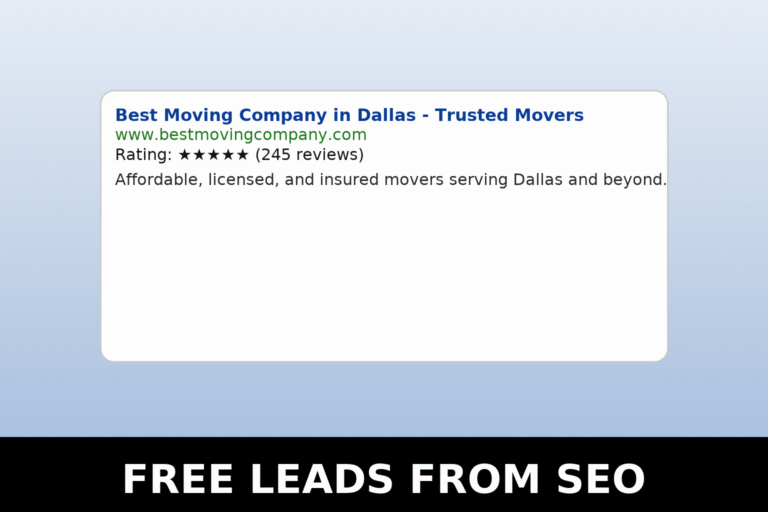
If your moving company is investing in SEO but your search results still look plain, just a blue link and a short description, you’re leaving clicks on the table. In competitive local markets, prospects compare movers in seconds. Richer search features like enhanced snippets, knowledge panels, and clearer business details can make your listing look more credible before someone ever lands on your website.
That’s where schema markup (structured data) comes in.
Schema markup is code added to your website that helps search engines understand what your business is, what services you offer, where you operate, and what content on your pages represents. Done correctly, it can improve how your business appears in search results and can support eligibility for certain rich results. While schema is not a direct “rank higher overnight” switch, it can increase visibility, relevance, and click-through rates by making your listing more informative and trustworthy.
At Best Moving Leads Providers, we’ve seen movers get stronger local performance when they combine the basics (great location pages, reviews, speed, conversion) with technical enhancements like structured data. This article breaks down the structured data types that matter for movers and how to implement them without creating a messy site.
What Schema Markup Really Does for Moving Companies
Search engines want to understand your site the same way a customer would: who you are, what you do, where you do it, and whether you’re credible. Schema markup gives them a standardized way to interpret those details.
For movers, structured data can help:
- Clarify your business type (moving company vs. storage vs. junk removal)
- Tie your services to specific pages (local moving, long-distance, packing, labor-only)
- Reinforce your location details (address, service area, phone, hours)
- Support more accurate display in knowledge panels and local results
- Improve how your pages are interpreted for AI-driven search features
It’s important to set expectations: schema doesn’t guarantee rich snippets, and Google can choose to ignore it if it’s inaccurate or spammy. But clean, truthful schema gives you a better chance at enhanced presentation.

The Schema Types Movers Should Prioritize
Many schema types exist, but movers don’t need to overcomplicate it. Focus on types that match your business model and website structure.
1) LocalBusiness (or a more specific subtype)
For most moving companies, LocalBusiness is the foundation. It describes your company as a real-world entity with contact information and location context. Depending on your services, you may also use a more specific subtype such as MovingCompany if supported by schema definitions on schema.org.
This markup typically includes:
- Business name
- Address (if you have a public location)
- Phone number
- Website URL
- Hours of operation
- Logo and image
- Social profiles
- Service area (when applicable)
Why it matters: it supports entity understanding. Google can connect your website to your brand, location, and local profile more confidently.
2) Service schema for your core offerings
Movers frequently offer multiple services, and customers search for them separately: local moving, long-distance moving, packing, labor-only, specialty items, storage coordination.
Service schema helps you describe each offering clearly and connect it to the page where that service is explained.
Each service entry can include:
- Service name (e.g., “Local Residential Moving”)
- Description
- Provider (your LocalBusiness entity)
- Area served (city/region)
- Service type and category
- Potential audience (residential/commercial)
Why it matters: it ties “what you do” directly to the “page that proves it,” which improves relevance and indexing clarity.
3) FAQPage schema for high-intent question sections
Many moving websites have FAQs that customers search for directly:
- “How much do movers cost in [City]?”
- “Do movers charge travel time?”
- “How far in advance should I book?”
- “Do you provide boxes and packing supplies?”
When FAQs are present on a page and formatted appropriately, FAQPage structured data can help search engines understand the questions and answers. This can increase visibility for long-tail queries and can improve how your result appears, depending on search engine display rules.
Why it matters: it can increase SERP footprint and build trust before the click.

4) Review and AggregateRating (use carefully)
It’s tempting to slap star ratings everywhere in schema. Don’t.
Google has strict guidelines about when review markup is eligible for rich results and discourages “self-serving” review schema in certain contexts. For movers, a safe approach is to use review schema only when:
- Reviews are genuinely displayed on the page
- The page is specifically about a product/service where reviews are relevant
- You’re not misrepresenting third-party platform ratings
If you do use AggregateRating, it must match visible content and be accurate.
Why it matters: when eligible, ratings can increase click-through rate—but misuse can trigger manual actions or removal of rich results.
5) Organization schema (for brand/entity reinforcement)
If you have multiple locations or a larger brand presence, Organization schema can complement LocalBusiness by emphasizing your brand identity, logo, social profiles, and corporate info. Many movers combine this with LocalBusiness depending on site structure.
Where Schema Markup Should Live on a Moving Website
Schema is most effective when it aligns with your site architecture:
- Homepage: LocalBusiness/Organization basics, brand identity, primary contact
- Location pages: LocalBusiness elements specific to that city/branch (where legitimate)
- Service pages: Service schema describing that offering
- FAQ sections: FAQPage markup on pages with substantial Q&A content
- Contact page: Reinforce NAP consistency
The goal is consistency. Don’t create conflicting entities or mismatched addresses across pages.
JSON-LD: The Best Format for Most Movers
Schema can be implemented in multiple ways, but JSON-LD is typically preferred because it’s easy to add without disrupting page design. It lives in the page code and is readable for search engines.
You don’t need to be a developer to use schema, but you do need to be careful. A few wrong fields (like a fake address or inflated rating) can do more harm than good.
Best Practices (and Common Mistakes to Avoid)
Keep business information consistent everywhere
Your schema should match:
- Your website footer
- Your contact page
- Your Google Business Profile
- Major citations (Yelp, Angi, BBB if applicable)
Inconsistency confuses search engines and customers.
Don’t mark up what isn’t on the page
If your page doesn’t display FAQs, don’t add FAQ schema. If your page doesn’t show reviews, don’t add review schema. Schema should describe the content and reality—not the content you wish you had.
Avoid creating multiple “business entities” accidentally
This happens when a company marks up different names, addresses, or phone numbers across pages. For multi-location movers, treat each legitimate branch carefully, with a clear location strategy.
Focus on what increases trust
Schema is not only about rich results. It’s about reinforcing trust and clarity—especially important for movers where perceived legitimacy affects conversion.
How Schema Supports Click-Through Rate and Conversions
Even when schema doesn’t display a flashy feature, it can still support a better search presence by:
- Improving relevance signals for service-specific searches
- Reinforcing your brand entity for knowledge panels
- Supporting better indexing of location and service pages
- Helping search engines understand page purpose faster
And on the conversion side, schema supports what customers care about:
- “Are they local?”
- “Do they offer the service I need?”
- “Do they seem legitimate?”
When your search presence answers those questions faster, more people click—and more of those clicks turn into calls.

How Best Moving Leads Providers Helps Movers Turn Visibility Into Booked Jobs
Schema markup helps you earn stronger visibility and credibility in search—but the real ROI happens when visibility turns into booked moves. That requires tight website conversion, fast response, and a consistent flow of qualified prospects.
That’s why movers often pair SEO improvements with lead programs. Best Moving Leads Providers supports moving companies with exclusive and shared moving leads plus marketing strategy built to improve conversion rates, not just increase traffic. When your SEO foundation is stronger and your pipeline is steady, your growth becomes predictable.
Conclusion: Structured Data is a Competitive Edge for Modern Movers
In 2026, search results are more crowded, more visual, and more competitive than ever. Schema markup won’t replace great content, strong reviews, and a professional brand—but it enhances all of them by making your services easier for search engines to interpret and easier for customers to trust.
Start with the fundamentals: LocalBusiness schema for your company identity, Service schema for your core offerings, and FAQPage markup where it genuinely fits. Keep everything consistent, truthful, and aligned with what’s visible on your site. Over time, schema becomes one more advantage that helps your moving company stand out in the results—and earn the click.