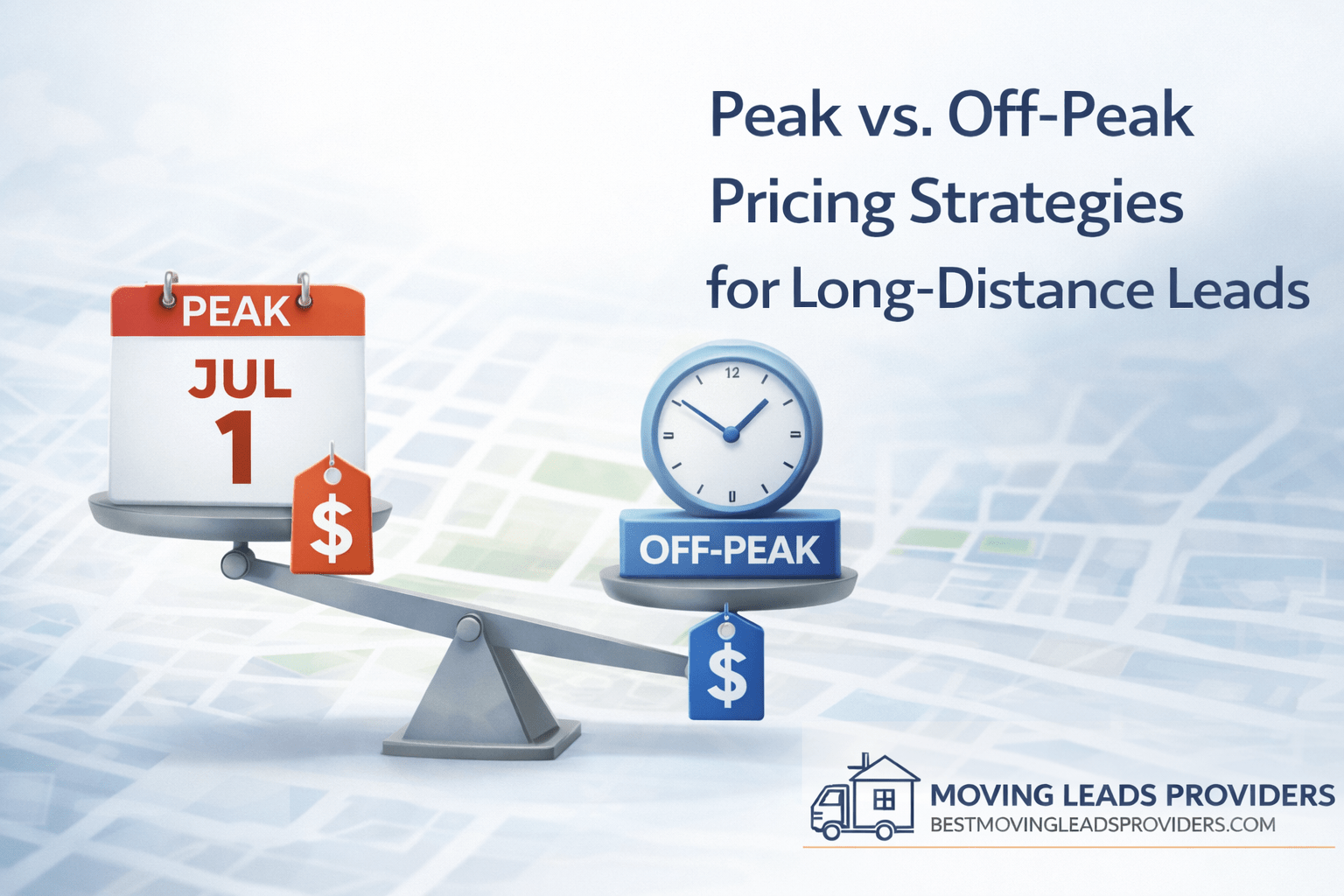
Peak vs. Off-Peak Pricing Strategies for Long-Distance Leads
Long-distance moving is where margins are made, or lost. Unlike local moves, these jobs involve more planning, higher operational costs, longer timelines, and greater customer expectations. That makes pricing strategy one of the most critical levers for profitability.
But here’s where many moving companies get it wrong: they apply static pricing in a highly dynamic market.
Demand for long-distance moves fluctuates significantly throughout the year. Summer months bring a surge of relocations, while winter and off-peak periods often see slower demand. If your pricing does not adapt to these shifts, you risk leaving money on the table during peak season and losing jobs unnecessarily during slower months.
Smart movers treat pricing as a flexible strategy, not a fixed number. By aligning pricing with demand, capacity, and customer psychology, you can increase revenue, improve close rates, and build a more resilient business.
Core Difference Between Peak and Off-Peak Long-Distance Demand
Long-distance moves are heavily influenced by timing. Families relocating across states prefer summer months. Corporate relocations often align with fiscal calendars. Weather conditions also play a major role in scheduling.
During peak periods, demand often exceeds available capacity. Trucks, crews, and timelines become limited resources. Customers are more motivated, deadlines are tighter, and competition shifts from price to availability and trust.
In off-peak months, the opposite happens. There is more availability, fewer urgent moves, and increased price sensitivity among customers. Movers compete more aggressively to secure bookings, and customers take more time comparing options.
Understanding this shift is the foundation of any effective pricing strategy.

What Dynamic Pricing Actually Means for Movers
Dynamic pricing does not mean randomly adjusting your rates. It means strategically increasing or decreasing pricing based on real factors like demand, route efficiency, fuel costs, crew availability, and lead quality.
For long-distance movers, this often includes:
- Adjusting rates based on time of year
- Pricing differently for flexible vs fixed move dates
- Increasing rates for high-demand routes
- Offering incentives for off-peak scheduling
- Aligning pricing with capacity utilization
The goal is simple: maximize revenue when demand is high and maintain volume when demand is low.
At Best Moving Leads Providers, we believe that this concept is central to scaling moving businesses. More leads alone are not enough. Pricing strategy determines how much value you extract from each lead.
Peak Season Pricing: Maximizing Revenue Without Losing Trust
Peak season is where many movers either thrive or burn out. The demand is there—but so is the pressure to perform.
Charge for Availability, Not Just Labor
During high-demand periods, your availability becomes a premium asset. Customers are often willing to pay more for guaranteed scheduling, reliable timelines, and experienced crews.
This is where pricing should reflect not just the cost of the move, but the value of securing a trusted provider during a busy time.
Instead of competing on price, position your service around reliability, protection, and execution.
Use Tiered Pricing Based on Urgency
Not all peak-season customers are the same. Some plan months in advance, while others need last-minute solutions.
Tiered pricing allows you to capture both segments effectively. Customers with flexible timelines may receive standard pricing, while urgent or last-minute bookings are priced higher due to operational strain.
This approach protects your margins while still accommodating different customer needs.
Avoid Overbooking at Discounted Rates
One of the most common mistakes movers make is locking in too many jobs early at lower rates, only to face capacity issues when higher-paying opportunities arise later.
Peak season pricing should account for future demand. Holding inventory (your trucks and crews) for higher-value jobs can significantly improve overall profitability.

Off-Peak Pricing: Driving Volume Without Undervaluing Your Service
Off-peak months require a different mindset. The goal shifts from maximizing price to maintaining consistent volume and cash flow.
Incentivize Flexibility
Customers moving during slower months are often more flexible. This creates an opportunity to offer strategic discounts or incentives in exchange for scheduling advantages.
For example, offering lower rates for mid-week moves or flexible delivery windows can help optimize your operations while still securing bookings.
Bundle Services to Increase Value
Instead of simply lowering prices, consider adding value. Bundling services like packing, storage, or specialty handling can make your offer more attractive without drastically reducing margins.
This approach positions your company as a premium provider even during slower periods.
Target Different Customer Segments
Off-peak months are ideal for targeting segments that are less seasonal. This includes corporate relocations, military moves, downsizing clients, and long-distance renters.
Adjusting your messaging and outreach during these periods helps maintain lead flow when traditional residential demand slows down.
At Best Moving Leads Providers, this is where strategic lead generation plays a major role. By aligning lead sources with seasonal demand shifts, movers can keep their pipeline active year-round.
Communicating Pricing Without Losing the Customer
Pricing strategy is not just about numbers, it is about perception.
Customers do not always choose the cheapest option. They choose the option that feels most justified.
Be Transparent About Seasonal Demand
Explaining why prices vary based on timing can build trust. Customers understand that summer is busier and winter is slower. When you communicate this clearly, pricing adjustments feel reasonable rather than arbitrary.
Focus on Value, Not Just Cost
During peak season, emphasize reliability, experience, and protection. During off-peak months, highlight flexibility, convenience, and added services.
The key is to match your messaging to the customer’s mindset at that time of year.
Use Data to Support Your Positioning
If you can demonstrate demand trends, availability constraints, or service benefits, your pricing becomes easier to justify. Confidence in your pricing often leads to higher conversion rates.

The Role of Lead Quality in Pricing Strategy
Not all long-distance leads should be treated equally.
High-intent leads with clear timelines and larger moves often justify premium pricing. Lower-intent leads or smaller moves may require more competitive rates.
Data and lead insights play a crucial role here. When you understand the context behind each lead, you can price more accurately and avoid leaving money on the table.
This is why combining dynamic pricing with high-quality lead generation is so powerful. Best Moving Leads Providers helps moving companies not only generate leads but also understand and segment them for better decision-making.
Building a Pricing System That Scales
The most successful moving companies do not adjust pricing manually for every job. They build systems.
This includes:
- Tracking seasonal demand trends
- Monitoring close rates at different price points
- Analyzing route profitability
- Adjusting pricing frameworks based on performance data
Over time, this creates a predictable model. You know when to raise prices, when to offer incentives, and how to balance volume with profitability.
It also removes guesswork. Instead of reacting to market conditions, your business operates with a clear pricing strategy.

Conclusion
Peak and off-peak pricing strategies are essential for any moving company handling long-distance leads. Static pricing limits your ability to adapt, compete, and grow in a seasonal industry.
By implementing dynamic pricing, you can maximize revenue during high-demand periods and maintain steady bookings during slower months. More importantly, you can position your business as both competitive and professional, regardless of the season.
The real advantage comes from combining smart pricing with strong lead generation. That is where Best Moving Leads Providers delivers the most impact. With the right leads and the right pricing strategy, moving companies can create a scalable system that drives consistent growth.