Transcribing Calls & Chats to Improve Lead Qualification
Every moving lead tells a story. A customer may be planning a local apartment move, comparing long-distance moving companies, requesting packing help, relocating an office, or searching for last-minute availability. The challenge for moving companies is that these details are often scattered across phone calls, website chats, text messages, emails, and CRM notes.
When lead information is incomplete or poorly recorded, sales teams lose valuable context. A rep may forget whether the customer needed storage. A dispatcher may not see that the move involves stairs or specialty items. A manager may not know which lead source generated the strongest conversations. These small gaps can create missed opportunities, inaccurate estimates, and slower follow-up.
That is why call and chat transcription has become one of the most useful tools for modern moving companies. By turning conversations into searchable text, movers can qualify leads more accurately, train sales teams more effectively, and build a stronger path from inquiry to booked move.
At Best Moving Leads Providers, we help moving companies grow through exclusive and shared moving leads, as well as digital marketing services. But successful lead generation depends on more than lead volume. To get the best return, movers need a system for understanding each prospect quickly and responding with the right message at the right time.
Why Transcription Matters in Moving Lead Qualification
Lead qualification is the process of determining whether a prospect is a good fit for your services, how urgent their need is, and what type of follow-up they require. For moving companies, this often means identifying the customer’s origin and destination, move date, home or office size, inventory, access conditions, packing needs, storage requirements, budget expectations, and decision timeline.
Without transcription, much of this information depends on manual note-taking. That creates room for error. A sales representative may capture the move date but miss that the customer has a piano. Another rep may write down the destination city but forget that the customer requested full packing. In a busy moving office, these details matter.
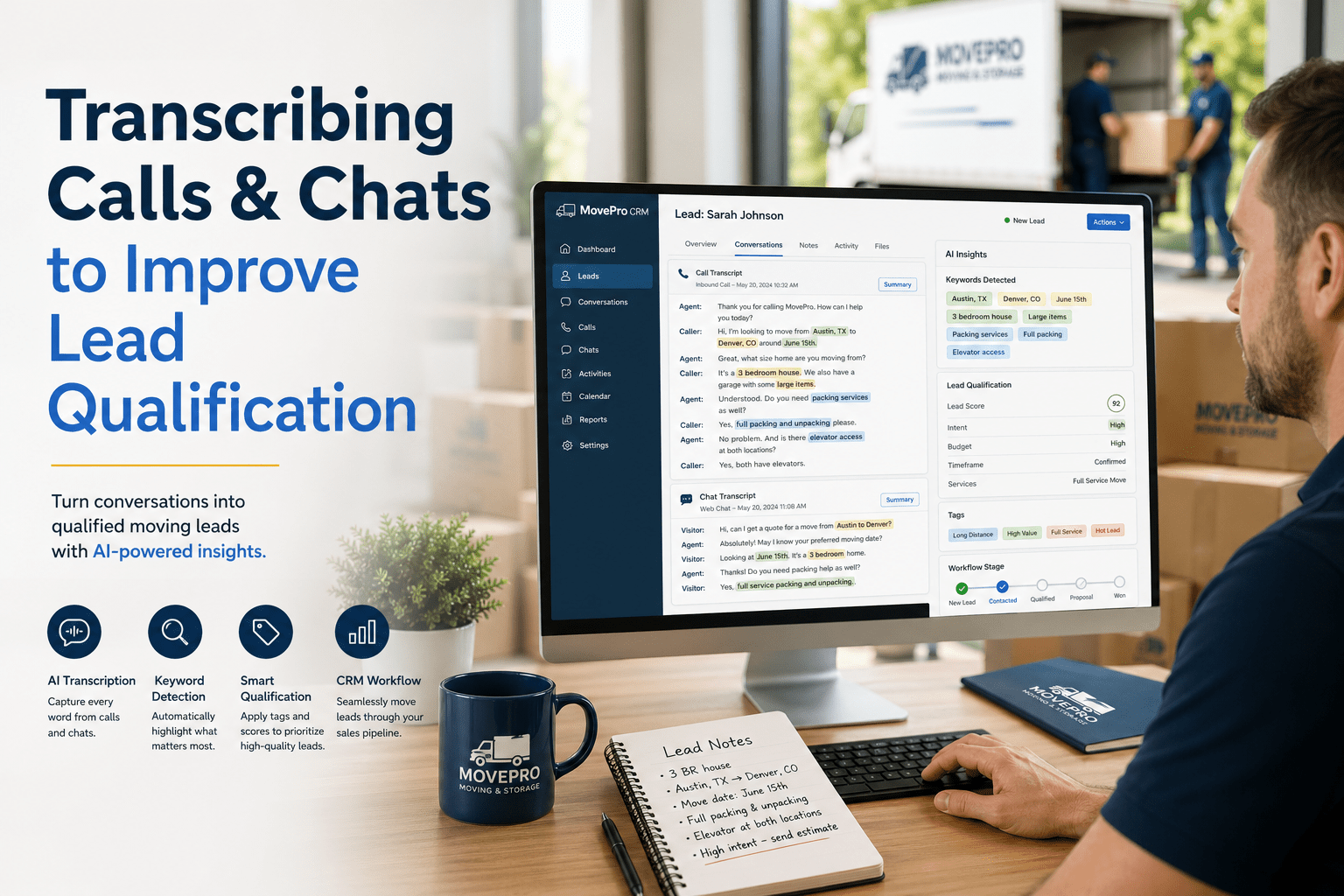
Transcription software helps by creating a written record of conversations. Many modern conversation intelligence platforms can also generate summaries, detect keywords, identify action items, and connect notes to CRM records. Microsoft’s Dynamics 365 conversation intelligence, for example, supports call transcription, real-time insights, and call summaries for sellers using integrated Teams calls.
For movers, this means calls and chats become more than one-time conversations. They become structured sales data.

Turning Conversations Into Better Lead Profiles
A moving lead is only as useful as the information attached to it. A name and phone number are not enough. To qualify a lead properly, your team needs context.
Transcribed calls and chats make it easier to build complete lead profiles. Instead of relying on memory, sales teams can search the transcript for key details such as “two-bedroom,” “storage,” “elevator,” “packing,” “out of state,” “commercial,” “fragile,” “quote,” or “move date.”
This is especially helpful when multiple people touch the same lead. A first responder may handle the initial inquiry, a senior estimator may prepare the quote, and an operations manager may later review the move details. When everyone can see the actual conversation history, handoffs become smoother.
Transcripts also reduce the risk of asking the customer the same questions repeatedly. A prospect who already explained their move does not want to start over with every new person. Better internal visibility helps your company sound organized, professional, and attentive.
Using Call Transcription to Score Moving Leads
Not all moving leads have the same value or urgency. Some prospects are ready to book immediately. Others are casually researching. Some are a perfect fit for your company’s service area and pricing model. Others may be outside your coverage, too small for your minimum job size, or not aligned with your availability.
Transcription allows moving companies to create smarter lead scoring rules. A transcript can reveal important buying signals, such as a customer saying they need to move next week, want a binding estimate, are comparing quotes, or have already chosen a move date. It can also highlight high-value service needs, such as long-distance relocation, packing, storage, specialty item handling, or commercial moving.
On the other hand, transcripts can help identify lower-priority leads. A prospect who says they are “just checking prices for next year” may still be worth nurturing, but they should not receive the same urgent treatment as someone moving in five days.
This type of lead scoring helps sales teams focus their time. Instead of treating every inquiry equally, movers can prioritize leads with the highest booking potential.
Improving Follow-Up Quality With Conversation History
Follow-up is where many moving companies lose deals. A customer may request a quote, speak with a rep, and then go quiet. If the next follow-up is generic, the company may not regain attention.
Transcripts make follow-up more specific and persuasive. Instead of saying, “Are you still interested in moving services?” a rep can say, “I wanted to follow up on your move from Tampa to Atlanta in late May and the packing help you mentioned for your kitchen and fragile items.”
That level of detail shows the customer that your team listened. It also makes the message feel less automated, even when the follow-up is supported by a CRM workflow.
This is where transcription and automation work especially well together. A call transcript can feed notes into a CRM, trigger follow-up tasks, and help reps personalize the next message. HubSpot’s ecosystem includes transcription-related integrations such as Fireflies.ai, which records and transcribes HubSpot Dialer calls and turns them into notes and summaries.
For moving companies buying leads from Best Moving Leads Providers, this kind of process can help convert more inquiries into booked estimates by making every follow-up more relevant.

Chat Transcription for Website and Digital Leads
Phone calls are not the only conversations worth capturing. Many prospects start with website chat, chatbot questions, SMS, or social media messages. These interactions can reveal early intent before the customer ever speaks with a sales rep.
Chat transcripts can show what pages a prospect visited, what questions they asked, what services they mentioned, and whether they requested pricing or availability. For example, a visitor who asks, “Do you move offices after hours?” is very different from someone asking, “Do you sell boxes?” Both may be useful leads, but they require different handling.
Website chat transcripts can also help identify gaps in your marketing. If many visitors ask whether you offer interstate moving, your website may need clearer service pages. If people repeatedly ask about packing, storage, insurance, or availability, those topics may deserve stronger content.
For moving companies, chat transcription is not just a sales tool. It is also a marketing intelligence tool.
Software Tools That Support Transcription and Conversation Intelligence
There are several categories of tools moving companies can use for call and chat transcription.
CRM platforms with conversation intelligence can connect transcripts directly to lead records. This is useful for sales teams that want all communication history in one place.
Call tracking platforms can record and transcribe inbound calls from ads, landing pages, and lead campaigns. These tools are especially helpful when movers want to understand which marketing channels produce the best conversations.
Sales conversation intelligence platforms can analyze calls, summarize discussions, detect themes, and support coaching. Gong, for example, is widely known for conversation intelligence and connects sales conversations with CRM data and deal insights through its ecosystem.
Communication APIs and voice platforms can also support custom transcription workflows. Twilio’s documentation describes real-time transcription capabilities that stream call audio to speech-to-text systems during live calls.
The best choice depends on your company’s size, lead volume, sales process, and technology stack. A small local mover may only need call recording, basic transcription, and CRM notes. A multi-location moving company may need advanced call analytics, lead scoring, routing, and management dashboards.
Training Sales Teams With Real Conversations
Transcripts are valuable because they show what actually happened in a sales conversation, not what someone remembers happening.
Managers can review transcripts to identify strong sales behaviors and missed opportunities. Did the rep ask about move date, inventory, access details, and packing needs? Did they explain the next step clearly? Did they handle pricing questions professionally? Did they ask for the booking or schedule the estimate?
This creates a better coaching process. Instead of giving vague feedback, managers can point to specific conversation moments. They can also build scripts based on real customer language.
For example, if many prospects ask whether the estimate is binding, your team can prepare a clear explanation. If commercial leads repeatedly ask about weekend availability, your sales team can address that earlier in the conversation. If long-distance customers often express concern about delivery windows, your reps can proactively explain the process.
Over time, transcripts help moving companies build a more consistent and confident sales operation.

Compliance and Customer Trust
Call and chat transcription must be handled responsibly. Moving companies should understand applicable consent rules for recording and transcribing conversations. Requirements can vary by location, so businesses should use clear notices and consult appropriate legal guidance when needed.
Beyond compliance, customer trust matters. Prospects should feel that communication tools are being used to serve them better, not to create a cold or invasive experience. Transcription should support accuracy, accountability, and better service.
Companies should also protect customer data carefully. Moving conversations may include addresses, phone numbers, emails, timelines, and personal details. Access to transcripts should be limited to the people who need them, and systems should be selected with privacy and security in mind.
How Best Moving Leads Providers Helps Movers Get More From Every Lead
Best Moving Leads Providers helps moving companies generate opportunities through exclusive moving leads, shared moving leads, and digital marketing services. But we also know that the companies that grow fastest are not just the ones receiving leads. They are the ones learning from every conversation.
Transcribing calls and chats helps movers understand lead quality, improve response strategies, refine sales scripts, and identify which marketing channels bring serious customers. It gives owners and managers a clearer picture of what prospects are asking, what objections appear most often, and what follow-up steps are needed to close more jobs.
When combined with strong lead generation, transcription can help moving companies build a smarter and more scalable sales system.

Conclusion
Call and chat transcription gives moving companies a practical advantage in lead qualification. It captures important details, improves CRM accuracy, strengthens follow-up, supports lead scoring, and helps sales teams learn from real conversations.
For movers competing in a fast-moving market, this level of visibility can make a measurable difference. A transcript can reveal whether a lead is urgent, high-value, service-ready, or still early in the research stage. It can also help your team respond with more confidence and less guesswork.
With the right transcription tools and a reliable moving lead generation partner like Best Moving Leads Providers, moving companies can turn everyday conversations into better decisions, stronger customer experiences, and more booked moves.