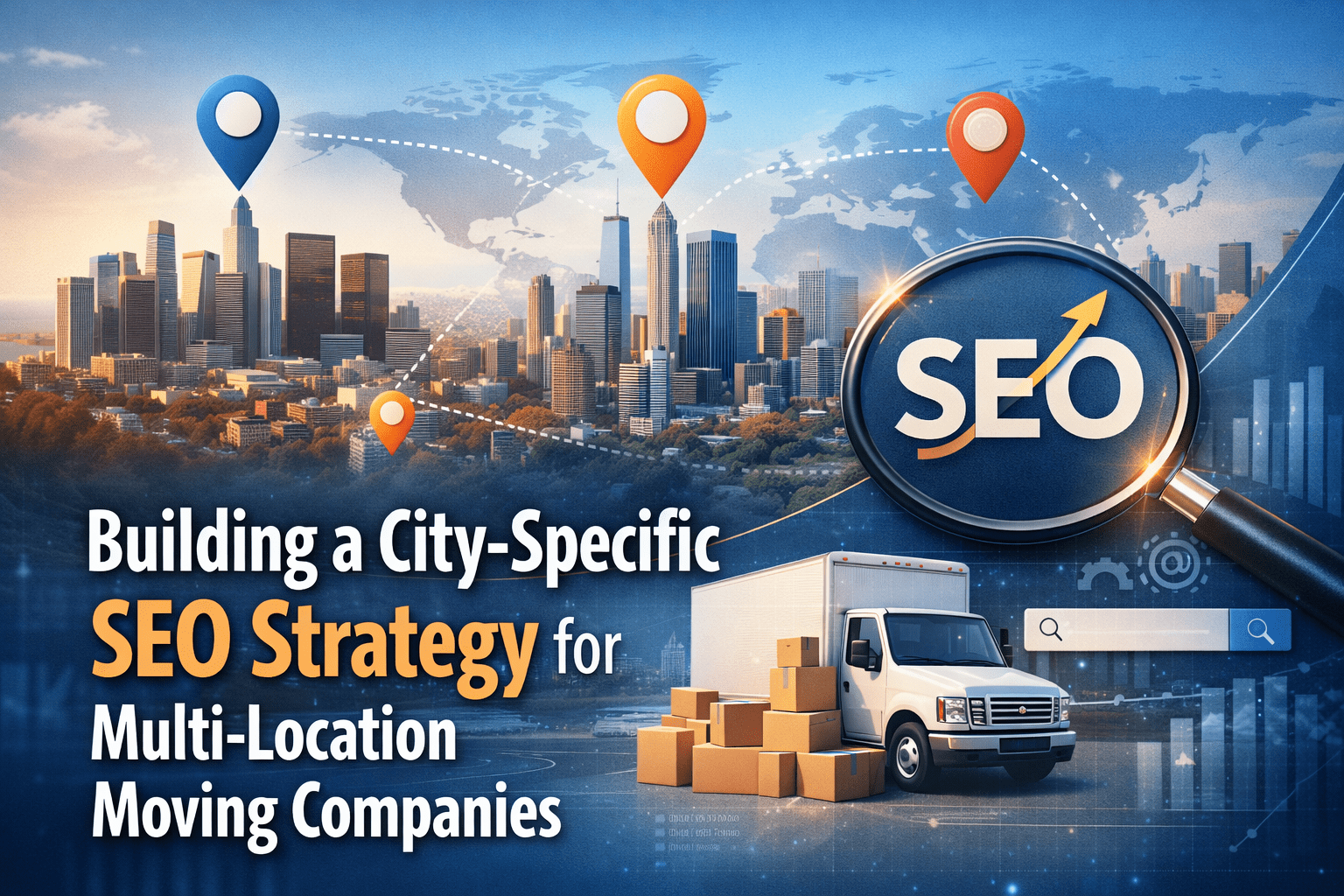
Building a City-Specific SEO Strategy for Multi-Location Moving Companies
If you operate in more than one city, SEO can either become your biggest growth engine—or a messy collection of duplicate pages that never rank. Multi-location moving companies often have the trucks, crews, and operational coverage to win multiple markets, but their websites and Google Business Profiles don’t clearly communicate local relevance. The result is predictable: they show up inconsistently in maps, struggle to rank organically in secondary cities, and end up leaning too heavily on ads to fill the calendar.
A strong city-specific SEO strategy fixes that. It helps search engines understand where you operate, helps customers trust you in each market, and creates a scalable framework as you expand. At Best Moving Leads Providers, we see multi-location movers get the best results when they treat each city like its own mini-market—while still keeping brand consistency, operational clarity, and high conversion standards across the company.
This guide walks through how to build a practical, rank-worthy city SEO system: location pages that aren’t thin duplicates, localized content that supports those pages, and Google Business Profile optimization that drives map visibility in every city you serve.
Why City-Specific SEO is Different for Multi-Location Movers
Single-location movers can pour all authority into one service area. Multi-location movers must balance:
- Relevance (showing up for “movers in City A” and “movers in City B”)
- Authority (not splitting your SEO strength so thin that nothing ranks)
- Trust (customers want local proof, not generic claims)
Your SEO has to signal both: “We’re a real company with systems,” and “We’re genuinely local in this city.”
That’s why city SEO isn’t just about spinning up pages with different city names. It’s about building a clear local footprint—online and in search engines—across multiple markets.
Start With the Right Site Structure for Multiple Cities
Before you write new pages, set up a structure that scales cleanly. A common approach for multi-location moving companies is:
- A main “Locations” hub page
- Individual city location pages (one per city)
- Optional neighborhood/suburb support pages (only where it makes sense)
- Core service pages (local moving, long-distance, packing, storage) that can be linked from each city page
This avoids two major problems: orphan pages that don’t get internal authority, and a website that becomes cluttered with hundreds of thin “near me” pages.
A simple hierarchy often works best:
/locations/
/locations/city-a/
/locations/city-b/
Then each city page links to the specific services offered in that city.
How to Create City Location Pages That Actually Rank
Your city pages are the backbone of multi-location SEO. These pages should do two jobs at once: rank for city-intent keywords and convert visitors into calls and quote requests.
What every city page should include
A strong city page isn’t just a “service area” page—it’s a local landing page built for trust.
Include:
- A city-specific headline and value proposition
- Clear services offered in that city (local, long-distance, packing, labor-only, storage if applicable)
- A “how it works” section describing your process
- Proof elements: reviews, photos, local move examples, team/truck images
- A service area map or list of nearby neighborhoods/suburbs you cover
- FAQs specific to that city (parking rules, apartment buildings, seasonal demand, common move types)
- Strong calls-to-action (call, text, request a quote)
Make city content unique without fluff
Google doesn’t reward pages that are “unique” only because you changed the city name. It rewards pages that are genuinely useful.
Good ways to create real differentiation:
- Talk about housing types common in the city (condos vs. single-family vs. historic homes)
- Address logistical realities (downtown parking, elevator reservations, narrow streets, HOA rules)
- Mention the types of customers you serve there (students, military, corporate relocations, retirees)
- Include city-specific service policies where relevant (parking coordination, COI for high-rises, move-in windows)
This isn’t about keyword stuffing. It’s about creating a page that feels like it was written by a mover who actually works in that city.
Add local media that builds trust
Photos and short videos matter more than most movers realize. Ideally, each city page has:
- Local job photos (even 3–5 makes a difference)
- A team photo with a local backdrop
- A short “moving in [City]” video clip
These assets improve conversion and strengthen local relevance signals.

Localized Content That Supports City Pages
City pages rank better when they’re supported by a content ecosystem. Think of city pages as your “money pages” and localized content as the supporting network that feeds them authority, relevance, and internal links.
Create city-specific blog content (but keep it strategic)
Instead of generic blogs, create content that matches real local intent:
- “Moving to [City]: Neighborhood guide for families”
- “Parking and move-day rules in downtown [City]”
- “Best time to move in [City] (weather + lease cycles)”
- “Apartment moving checklist for [City] renters”
Then link each article back to the relevant city page with natural anchor text (“our [City] moving team,” “get a quote for moving in [City]”).
Build city-based FAQ clusters
FAQs can win long-tail searches and improve conversion. Consider adding:
- A city FAQ section on each city page
- A dedicated FAQ page per city if there’s enough volume and complexity
When someone searches “Do movers need permits in downtown [City]?” you want to be the page that answers clearly and nudges them into a quote.
Highlight local partnerships and community signals
If you have relationships with real estate offices, property managers, storage facilities, or charities in each city, mention them (accurately and professionally). Community signals help your brand feel “present” in each market.
Google Business Profile Optimization Across Multiple Cities
For movers, Google Business Profile (GBP) is often the #1 driver of local calls. Multi-location brands must treat GBP like a portfolio: each listing should be accurate, active, and locally relevant.
One listing per real location
Each city should have its own GBP only if you have a legitimate business presence that meets Google’s guidelines (typically a staffed office location or properly supported service-area business listing). Don’t create fake locations—those often lead to suspensions and long-term ranking issues.
Keep NAP consistent, but locally accurate
NAP = Name, Address, Phone. Across listings:
- Use consistent brand naming (avoid random variations)
- Make sure hours and categories match actual operations
- Keep service areas specific and realistic for that city
- Ensure the website link points to the correct city page
Use city-specific posting and photos
Most movers underuse GBP posts. In each city listing:
- Post weekly or biweekly updates about availability, tips, and seasonal reminders
- Upload local photos regularly (crews, trucks, job sites)
- Add service photos that show protection methods and professionalism
A listing with fresh activity tends to look more credible to customers—and often performs better in practice.
Build reviews the right way across locations
Reviews are not just volume; they’re relevance. A city listing with reviews mentioning that city can perform better for local queries and convert higher.
Encourage customers to leave details:
- “What neighborhood were you moving from/to?”
- “What service did we provide (packing, local move, long-distance)?”
You can’t script reviews, but you can ask for specificity.
Avoid These Multi-Location SEO Mistakes
Multi-location moving SEO breaks when companies:
- Publish near-duplicate city pages with thin content
- Create too many suburb pages too fast without real differentiation
- Point all GBP listings to the homepage instead of city pages
- Ignore internal linking and leave city pages buried
- Use inconsistent NAP data across directories and citations
The fix is usually not “more pages.” It’s better structure, better location content, and stronger local proof.

How Best Moving Leads Providers Fits Into a Multi-Location Growth Plan
City-specific SEO is a long-term asset. But multi-location movers often need consistent lead flow while those pages gain authority and rankings.
That’s where Best Moving Leads Providers supports growth: combining exclusive and shared moving leads with marketing guidance so you can keep trucks booked in each market while your local SEO footprint strengthens city by city. The smartest multi-location operators build both: a scalable organic presence and a predictable inbound pipeline.
Final Word: Treat Every City Like Its Own Market
Multi-location SEO works when you respect local reality. Each city has its own housing mix, moving patterns, and customer expectations. If your website and Google Business Profiles reflect that—through strong city pages, localized supporting content, and active GBP management—you’ll start ranking in multiple cities without relying entirely on paid ads.
Build the foundation first. Create city pages that are truly useful. Support them with localized content and internal links. Optimize each Google Business Profile like it’s the front desk of that city office. Do that consistently, and your multi-location brand won’t just “serve” multiple cities—you’ll be visible, trusted, and booked in them.
FAQs
Typically one strong page per city where you have real operations. Add neighborhood/suburb pages only when you can create genuinely unique, useful content.
No. Each city listing should link to the most relevant city page to strengthen local relevance and improve conversion.
Focus on real local differences: housing types, parking/logistics, common move scenarios, local policies, photos, reviews, and city-specific FAQs.
You can sometimes rank organically with strong content and authority, but map visibility is harder without a legitimate local presence. Focus on clear service-area coverage and trustworthy signals.
Improve Google Business Profile activity, review generation, and city page quality. Then support those pages with localized content and strong internal linking.