How to Track ROI from Purchased Moving Leads
Purchasing moving leads can be one of the most effective ways to keep your pipeline full, but only if those leads actually turn into profitable moves. The problem? Many moving companies spend money on leads without knowing whether they’re getting their money’s worth.
If you want to maximize your marketing budget, you need to track ROI (Return on Investment) from your purchased moving leads. This guide will show you exactly how to measure, analyze, and improve your ROI so you can invest in leads with confidence.
Step 1: Define What Counts as ROI for Your Moving Company
ROI in the moving industry isn’t just about immediate revenue, but it’s about total lifetime value (LTV) of a customer. For example, a client might book a local move now but could call you again for a long-distance relocation in the future or refer you to friends.
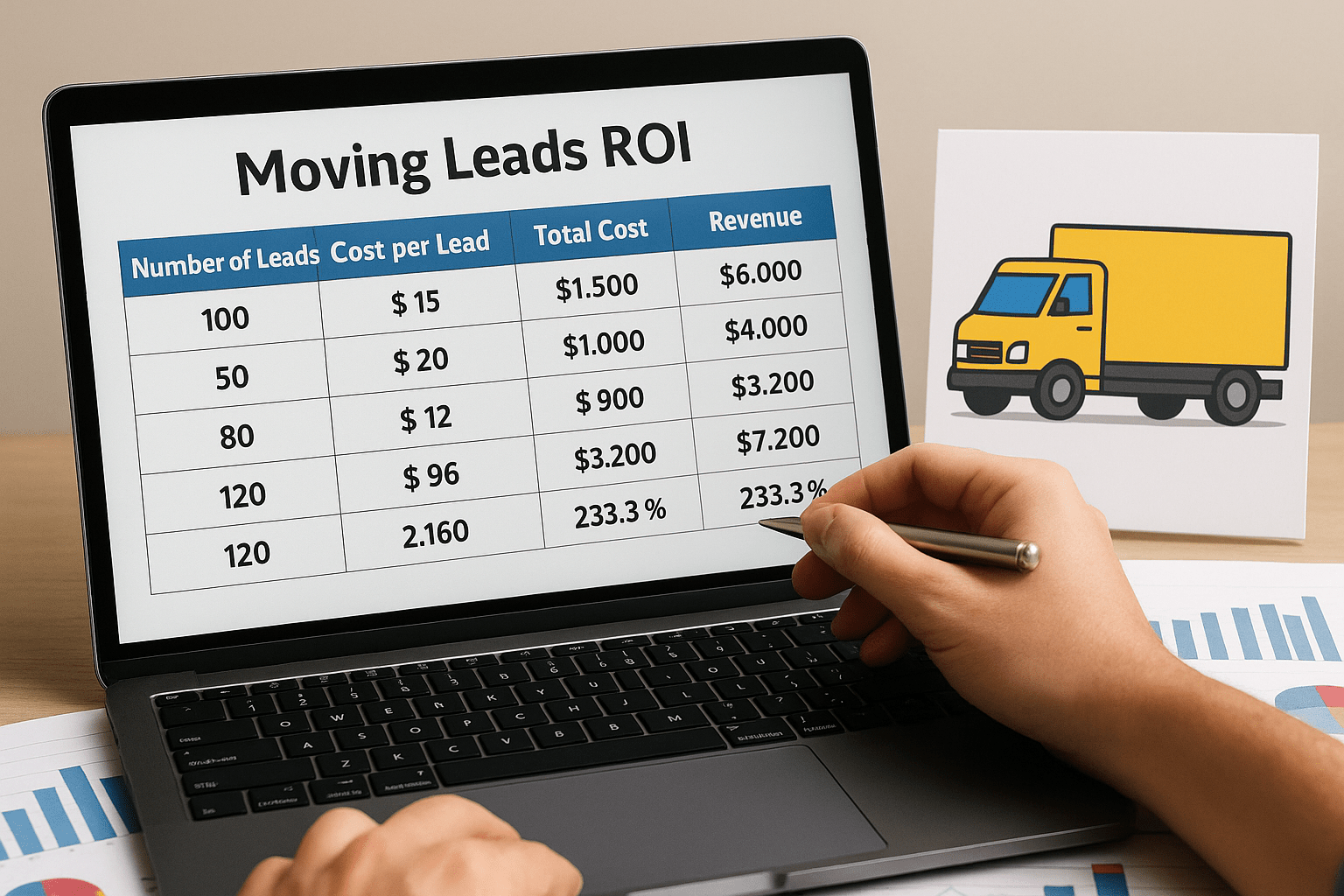
ROI (%) = [(Total Revenue from Leads – Total Cost of Leads) / Total Cost of Leads] × 100
Example: If you spend $1,000 on leads and close $4,000 in moves from those leads:
ROI = (4,000 – 1,000) ÷ 1,000 × 100 = 300%

Step 2: Track Every Lead From the Start
You can’t calculate ROI if you don’t know where your leads came from.
Best Practices:
- Use a CRM like HubSpot, Best Movers CRM, or Salesforce to tag leads by source.
- Create separate tags for exclusive moving leads, shared leads, local moves, long-distance moves, etc.
- Always log the date purchased, cost per lead, and lead source.
Step 3: Record Conversion Rates by Lead Source
Not all leads convert equally. Some sources may produce fewer leads but deliver higher-paying customers.
Track these metrics:
- Number of leads purchased
- Number of leads contacted
- Number of quotes sent
- Number of moves booked
- Average value per booked job

Step 4: Calculate Cost Per Acquisition (CPA)
Your CPA tells you how much it costs to get a paying customer.
Formula:
CPA = Total Cost of Leads ÷ Number of Booked Moves
Example: If you spent $1,000 on 50 leads and booked 10 moves, your CPA is $100 per customer.
Step 5: Factor in Additional Costs
Leads aren’t your only expense—you also have to consider:
- Labor costs (sales reps calling leads)
- Fuel for on-site estimates
- Time spent following up
- Software subscriptions
Including these costs will give you a true ROI instead of a surface-level number.

Step 6: Analyze Profit Margins
A $500 job with a $400 margin is more profitable than a $2,000 job with a $200 margin after expenses. Track your net profit on each booked move, not just the revenue.
Step 7: Improve ROI With These Tips
- Buy higher-quality leads (exclusive or geo-targeted) to increase close rates.
- Follow up fast—the first mover to respond is often the one who gets booked.
- Nurture cold leads—some might book weeks later if you stay in touch.
- Cut underperforming sources and reinvest in the most profitable ones.

Why This Matters
Without tracking ROI, you’re guessing where your marketing budget should go. By using a structured approach, you’ll know:
- Which lead providers are worth the investment
- How much you can spend on leads while staying profitable
- How to scale without wasting money
At Best Moving Leads Providers, we make ROI tracking simple by providing leads with transparent data, clear source tracking, and higher close rates, so you can focus on turning calls into customers.
Reach out now to get high-quality leads for your moving business.