Analyzing Back-End Data to Reduce Lead Acquisition Costs
For moving companies, lead generation is only profitable when the numbers make sense. A campaign may produce a high volume of inquiries, but if those leads do not turn into estimates, booked jobs, and revenue, the real cost of growth can quietly climb. This is why successful movers do not judge marketing performance by lead volume alone. They look deeper into the back-end data.
Back-end data is the information that appears after a lead enters your sales process. It shows what happened after the inquiry came in: whether the lead was contacted, how fast your team responded, whether an estimate was scheduled, whether the job was booked, how much revenue it produced, and whether the customer was a good fit for your business.
When moving companies analyze this data properly, they can identify which lead sources are truly profitable, which campaigns are wasting budget, and which sales process gaps are increasing acquisition costs. At Best Moving Leads Providers, we help moving companies grow through exclusive moving leads, shared moving leads, and digital marketing services. But the smartest growth strategy is not just getting more leads. It is getting more of the right leads at a lower cost per booked move.
Why Lead Acquisition Cost Matters in the Moving Industry
Lead acquisition cost is the amount your moving company spends to generate a lead. But that number alone does not tell the full story. A low-cost lead may become expensive if it never answers the phone, falls outside your service area, or has no real intent to book. A higher-cost lead may be more valuable if it turns into a profitable long-distance move, commercial relocation, or full-service packing job.
This is why movers should look beyond cost per lead and focus on cost per qualified lead, cost per estimate, cost per booked move, and cost per completed job. These numbers provide a more accurate view of marketing performance.
For example, one campaign may generate leads at a low cost, but only a small percentage may become booked moves. Another campaign may cost more upfront but produce serious customers with larger move sizes and stronger booking intent. Without back-end data, your company may cut the wrong campaign or overspend on the wrong channel.

What Back-End Data Moving Companies Should Track
To reduce lead acquisition costs, moving companies need a clear view of the full customer journey. That journey begins when a prospect submits a form, calls your company, clicks an ad, requests a quote, or enters your CRM from a lead provider. It continues through follow-up, estimate scheduling, quote delivery, booking, service completion, and revenue reporting.
At minimum, your company should track lead source, move type, service area, move date, contact status, estimate status, booking status, job value, and reason for lost opportunity. These data points help you understand not only where leads are coming from, but also what happens to them.
Lead source is especially important. Your CRM should identify whether a prospect came from exclusive moving leads, shared moving leads, Google Ads, organic search, social media, referrals, repeat customers, email campaigns, or direct website traffic.
Move type also matters. Local residential moving, interstate moving, long-distance relocation, commercial moving, packing services, and storage-related inquiries may all produce different acquisition costs and profit margins.
When these details are tracked consistently, your company can make smarter marketing decisions based on actual performance instead of assumptions.
Looking Beyond Cost Per Lead
Cost per lead is one of the most common marketing metrics, but it can be misleading. Many moving companies make the mistake of choosing campaigns based only on which source generates the cheapest inquiries. This approach often leads to poor-quality leads, low contact rates, and wasted sales time.
A better metric is cost per booked move. This tells you how much you actually spent to acquire a paying customer. For example, if you spend $1,000 on a campaign and generate 100 leads, your cost per lead is $10. But if only two of those leads book, your cost per booked move is $500.
Now compare that with a campaign that costs $1,000 and generates only 40 leads. At first, the cost per lead looks worse at $25. But if eight of those leads book, your cost per booked move is only $125. The second campaign is clearly more efficient, even though the individual leads cost more.
This is where back-end data becomes powerful. It helps moving companies stop chasing cheap leads and start investing in profitable opportunities.

Using CRM Data to Identify High-Value Lead Sources
Your CRM should be the central hub for lead performance analysis. Every lead should be tagged by source and updated as it moves through the sales pipeline. When your team uses the CRM consistently, you can compare lead sources by contact rate, estimate rate, booking rate, average job value, and close rate.
This helps answer critical questions. Which lead sources produce the highest number of booked moves? Which sources generate the largest jobs? Which campaigns bring in customers who need packing, storage, or long-distance relocation? Which sources produce leads that rarely answer the phone?
For moving companies working with Best Moving Leads Providers, this type of tracking can help determine how exclusive and shared moving leads perform across different markets, services, and sales teams. It can also reveal whether your follow-up process is strong enough to convert the leads you are receiving.
The goal is not simply to collect data. The goal is to use that data to shift budget toward sources that produce revenue.
Measuring Sales Team Response and Conversion
Lead acquisition cost is not only a marketing issue. It is also a sales operations issue. Even high-quality leads can become expensive if your team responds too slowly, follows up inconsistently, or fails to schedule estimates.
Back-end data can show how quickly your team contacts new leads, how many call attempts are made, how often prospects are reached, and how many conversations turn into scheduled estimates. These numbers help identify whether the problem is lead quality or sales execution.
For example, if one lead source has a low booking rate but also a low contact attempt rate, the issue may not be the lead provider. It may be that your team is not following up quickly enough. If another source has a strong contact rate but poor estimate conversion, your sales script or pricing conversation may need improvement.
Response time is especially important in the moving industry. Customers often request quotes from multiple companies. The mover that responds first and communicates clearly often gains the advantage. By tracking response speed and conversion performance, companies can lower acquisition costs without increasing marketing spend.

Segmenting Data by Move Type and Service Area
Not all moving leads should be evaluated together. A local apartment move, a four-bedroom long-distance move, and a commercial office relocation have different values, timelines, and sales processes. If your company blends them into one report, the data may become too broad to guide decisions.
Segmenting data by move type helps you understand which services produce the best return. You may discover that long-distance leads cost more but generate stronger revenue. You may find that small local moves are easier to book but less profitable during peak season. You may see that commercial relocation leads take longer to close but produce higher job values.
Service area segmentation is also important. Some cities, counties, or neighborhoods may produce better customers than others. A campaign that works well in one market may underperform in another. By analyzing acquisition cost by location, movers can adjust ad targeting, landing pages, lead buying strategy, and sales coverage.
This level of detail allows your company to invest with precision.
Tracking Lost Lead Reasons
One of the most overlooked back-end data points is the reason a lead did not convert. Too many moving companies mark leads as “lost” without capturing why. This creates a major blind spot.
Lost reasons can reveal patterns that directly affect acquisition cost. Common categories may include price too high, no response, outside service area, unavailable move date, customer chose competitor, duplicate lead, job too small, or not ready to move.
When these reasons are tracked consistently, managers can take action. If many leads are lost because of no response, your follow-up cadence may need improvement. If many are outside your service area, your targeting or lead filters may need adjustment. If many choose competitors, your sales process, estimate presentation, or review strategy may need work.
Reducing acquisition costs often begins by understanding where leads are being lost and why.

Connecting Marketing Spend to Revenue
The most valuable back-end reporting connects marketing spend directly to revenue. This allows your company to calculate return on investment by campaign, source, service type, and market.
A lead source that produces ten booked jobs is useful, but it becomes far more meaningful when you know the total revenue and profit those jobs created. A campaign that generates smaller jobs may not deserve the same budget as one that produces full-service moves with packing and storage.
Revenue tracking also helps with seasonal planning. Moving demand often changes throughout the year. By reviewing past performance, your company can identify when acquisition costs rise, when booking rates improve, and when certain services become more profitable.
This gives moving companies the ability to plan budgets more intelligently instead of reacting month to month.
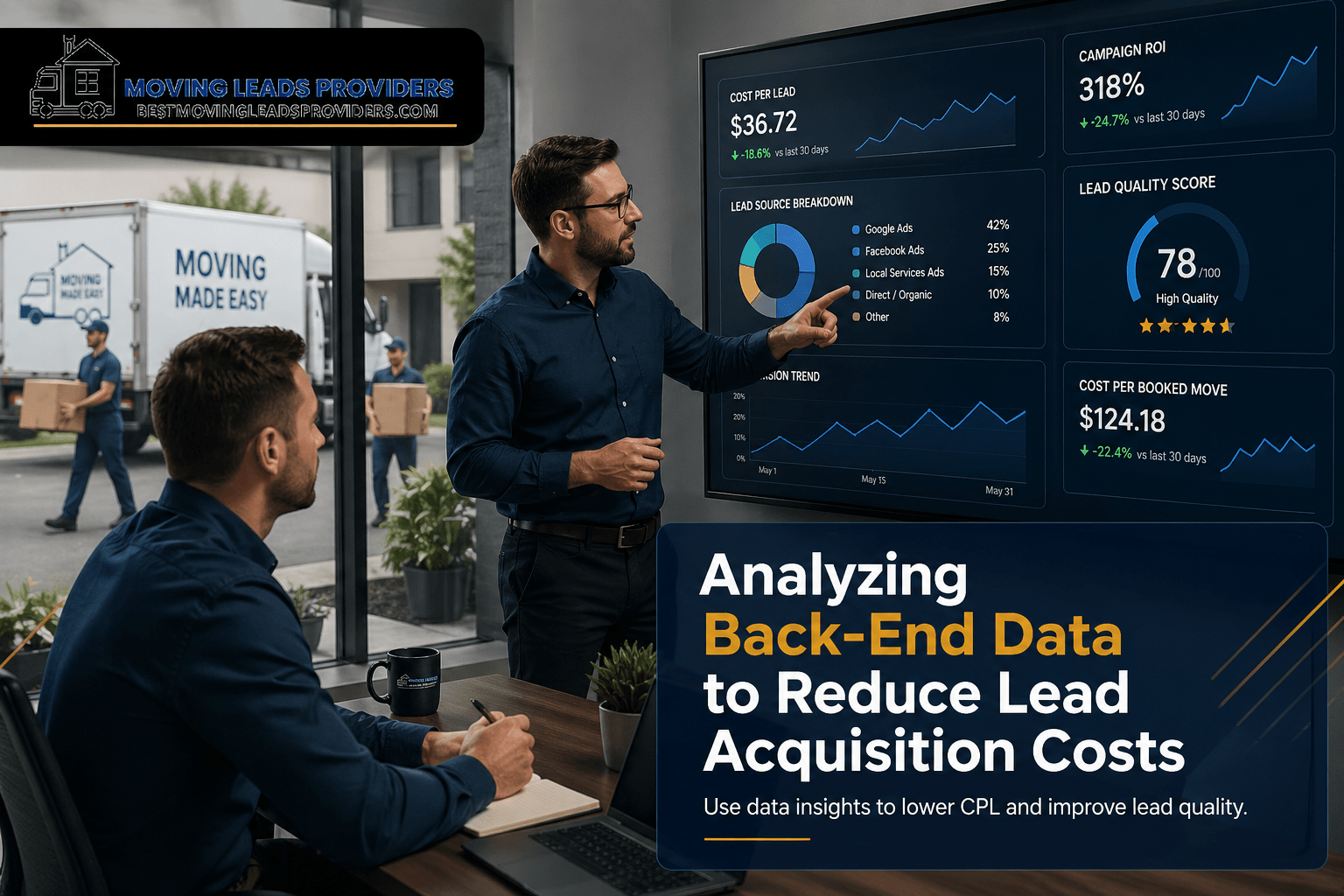
Using Dashboards to Make Data Easier to Understand
Back-end data is only useful when it is easy to review. Moving companies should create simple dashboards that show the metrics that matter most.
A useful dashboard may include total leads, qualified leads, contact rate, estimate rate, booking rate, average job value, cost per booked move, revenue by source, and lost lead reasons. These metrics should be reviewed regularly by owners, managers, sales leaders, and marketing partners.
The dashboard does not need to be overly complex. In fact, the best reporting is often simple and focused. The goal is to create visibility. When everyone can see which sources are working and which parts of the process need improvement, the company can make faster and better decisions.
How Best Moving Leads Providers Supports Smarter Growth
Best Moving Leads Providers helps moving companies access exclusive and shared moving leads designed to create real sales opportunities. But we also encourage movers to measure what happens after the lead is delivered.
When moving companies track back-end data, they can better understand lead quality, sales performance, market opportunities, and campaign profitability. This allows them to make informed decisions about how to allocate budget, improve follow-up, and scale with confidence.
A strong lead generation partner can help bring opportunities into your pipeline. A strong data process helps you convert those opportunities more efficiently.

Conclusion
Reducing lead acquisition costs is not just about finding cheaper leads. It is about understanding which leads create the best business outcomes. Back-end data gives moving companies the visibility they need to evaluate marketing performance from lead source to booked job.
By tracking lead source, move type, response speed, estimate rate, booking rate, job value, and lost reasons, movers can identify what is working and what needs improvement. They can shift budget toward profitable sources, strengthen sales follow-up, and reduce wasted spend.
For moving companies ready to grow, analyzing back-end data is one of the smartest ways to build a more efficient sales engine. When paired with high-quality lead generation from Best Moving Leads Providers, it can help lower acquisition costs, improve ROI, and turn more opportunities into profitable moves.