Segmenting Lead Types for Better Personalization
Not all moving leads should be treated the same, yet many moving companies still approach every inquiry with a one-size-fits-all strategy.
The result? Generic messaging, lower engagement, and missed conversion opportunities.
In today’s competitive landscape, personalization is no longer optional. Customers expect communication that reflects their specific needs, timelines, and priorities. And the only way to deliver that effectively is through proper lead segmentation.
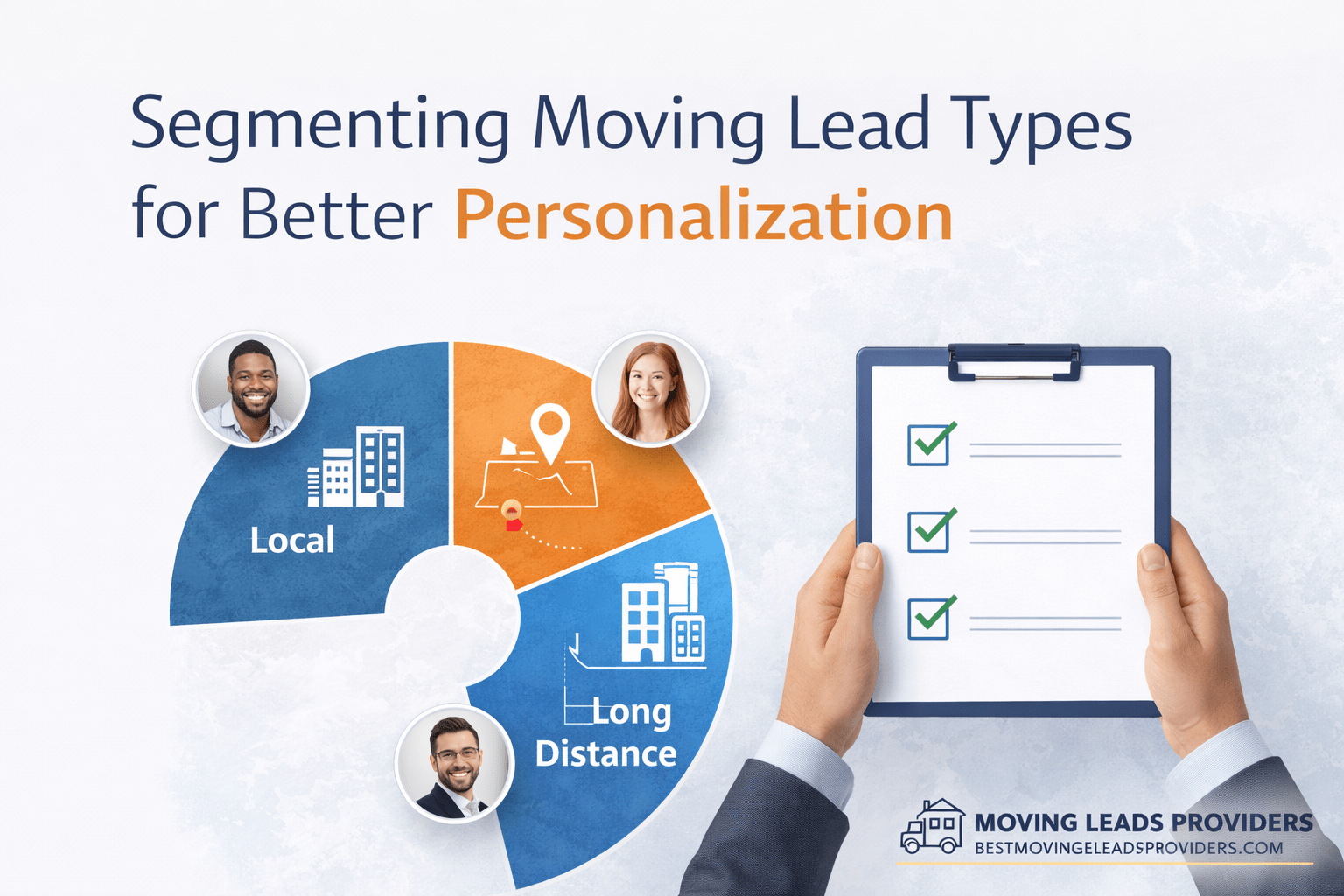
At Best Moving Leads Providers, we’ve seen how categorizing leads into distinct segments, such as local, long-distance, commercial, and auto transport, can dramatically improve both lead quality and conversion performance.
This guide explores how to segment your leads strategically and tailor your communication to turn more prospects into booked jobs.
Why Lead Segmentation Matters in the Moving Industry
Every type of move comes with different expectations, budgets, and decision-making processes.
A local residential move is vastly different from a cross-country relocation. A corporate office move has little in common with shipping a vehicle across states. When you treat all leads the same, your messaging becomes too broad to resonate with anyone.
Segmentation allows you to:
- Speak directly to customer needs
- Improve response relevance
- Increase trust and engagement
- Shorten sales cycles
Ultimately, it helps your business feel more professional, organized, and customer-focused.

The Four Core Moving Lead Segments
To build an effective segmentation strategy, you first need to define your core categories.
Local Moving Leads
Local leads typically involve short-distance moves within the same city or region.
These customers are often looking for speed, affordability, and convenience. Many are moving apartments, small homes, or shared spaces, and their decisions are usually made quickly.
Because of this, your communication should focus on simplicity and efficiency. Instead of overwhelming them with details, emphasize how easy and fast the process is.
Messaging that works well includes:
“Quick, hassle-free local moves with flexible scheduling.”
Local leads respond best to:
- Fast response times
- Clear, upfront pricing
- Same-day or short-notice availability
The goal is to remove friction and help them book quickly.
Long-Distance Moving Leads
Long-distance leads involve moves across states or regions and are typically higher in value.
These customers require more reassurance and detailed planning. Unlike local movers, they are more likely to:
- Compare multiple providers
- Ask detailed questions
- Take longer to make decisions
Your communication should reflect this.
Focus on professionalism, reliability, and experience.
Explain your process clearly, highlight safety measures, and provide transparency around timelines and pricing. This builds trust and reduces uncertainty, two key factors in converting long-distance leads.
At Best Moving Leads Providers, long-distance campaigns are designed to deliver high-intent prospects who are actively planning major relocations, making personalized communication even more impactful.
Commercial Moving Leads
Commercial leads involve office relocations, business moves, or corporate transitions.
These are fundamentally different from residential moves. Business clients are less concerned with price alone and more focused on minimizing disruption.
Downtime equals lost revenue, so efficiency and planning are critical. Your messaging should reflect a professional, solutions-driven approach.
Instead of focusing on basic moving services, highlight:
- Strategic planning
- After-hours or weekend moves
- Minimal operational disruption
- Dedicated project coordination
Commercial clients expect a higher level of communication and organization. They also often involve multiple decision-makers, which means your sales approach should be consultative and structured.
Auto Transport Leads
Auto transport is a specialized segment that requires a different communication strategy altogether.
Customers looking to ship vehicles are primarily concerned with safety, timing, and cost. They want assurance that their vehicle will arrive in the same condition it was picked up.
Your messaging should emphasize:
- Secure handling and transport methods
- Insurance coverage
- Delivery timelines
- Transparent pricing
Unlike traditional moving leads, auto transport customers are often highly research-driven. They compare options carefully and look for clear, trustworthy information.
This makes credibility and clarity essential.

Tailoring Communication for Each Segment
Once your leads are categorized, the next step is customizing how you communicate with each group. This is where segmentation truly delivers value.
Personalized Email and SMS Campaigns
Instead of sending generic follow-ups, tailor your messages based on lead type.
A local lead might receive:
“Need a quick move this week? We’ve got you covered with flexible local scheduling.”
A long-distance lead might receive:
“Planning a cross-state move? Our team ensures safe, reliable delivery with full transparency.”
This level of personalization increases engagement and keeps your brand top-of-mind.
Customized Sales Scripts
Your call center should adapt conversations based on lead category.
For example:
- Local leads → Focus on speed and availability
- Long-distance leads → Focus on trust and process
- Commercial leads → Focus on planning and efficiency
- Auto leads → Focus on safety and protection
At Best Moving Leads Providers, we often help moving companies refine their scripts to align with segmented lead flows, resulting in noticeably higher close rates.
Targeted Landing Pages
Sending all traffic to one generic page is a missed opportunity. Segment-specific landing pages allow you to speak directly to each audience.
For example:
- A local moving page emphasizing quick booking
- A long-distance page highlighting expertise and reliability
- A commercial page showcasing business solutions
- An auto transport page focusing on vehicle safety
This alignment between lead intent and messaging significantly improves conversions.

Using Data to Improve Segmentation Over Time
Segmentation is not a one-time setup, it should evolve based on performance data. Track how each segment behaves:
- Conversion rates
- Average job value
- Response times
- Customer feedback
Over time, you’ll identify patterns that help refine your approach. For example, you may discover that:
- Long-distance leads convert better with follow-up calls
- Local leads respond faster to SMS
- Commercial leads require longer nurturing cycles
These insights allow you to continuously optimize your strategy.
How Best Moving Leads Providers Enhances Lead Segmentation
Effective segmentation starts with high-quality lead data.
At Best Moving Leads Providers, we go beyond basic lead generation by delivering:
- Pre-qualified leads categorized by move type
- Detailed customer information for better personalization
- Campaign strategies tailored to each segment
- Conversion-focused marketing systems
This allows moving companies to immediately apply segmentation strategies without guesswork.
Conclusion
Personalization is the future of moving lead conversion, and segmentation is how you achieve it. By categorizing your leads into local, long-distance, commercial, and auto segments, you can align your messaging with customer intent and dramatically improve results.
Instead of treating every lead the same, you create a more relevant, engaging experience that builds trust and drives action. In a competitive market, that difference is what sets successful moving companies apart.
And with the right segmentation strategy in place, every lead becomes a better opportunity.

FAQs
It’s the process of categorizing leads based on move type so you can tailor communication and improve conversions.
Yes. Personalized messaging is more relevant, which increases engagement and booking rates.
Begin by categorizing them into core groups like local, long-distance, commercial, and auto transport.
Absolutely. Even simple segmentation can significantly improve communication and results.