Top 5 Best Moving CRM Picks for 2026
In the moving industry, CRM software has evolved from a “nice-to-have” to a core operational system. Between juggling lead intake, estimates, dispatch, paperwork, customer communication, and billing, moving companies handle a level of complexity that can’t be managed efficiently with spreadsheets, sticky notes, or disconnected tools. A solid CRM centralizes these moving parts so your team can work faster, make fewer mistakes, and deliver a more consistent customer experience—especially when schedules are tight and details matter.
Heading into 2026, the best moving CRMs aren’t just contact databases. They’re operational platforms designed to manage the full lifecycle of a move: lead capture, quoting, booking, dispatching, storage management, billing, and post-move follow-up. Throughout 2025, the biggest trends across leading CRMs were clear: smarter automation, AI-assisted workflows, improved mobile capabilities, better visibility into day-to-day operations, and deeper integrations that reduce manual work.
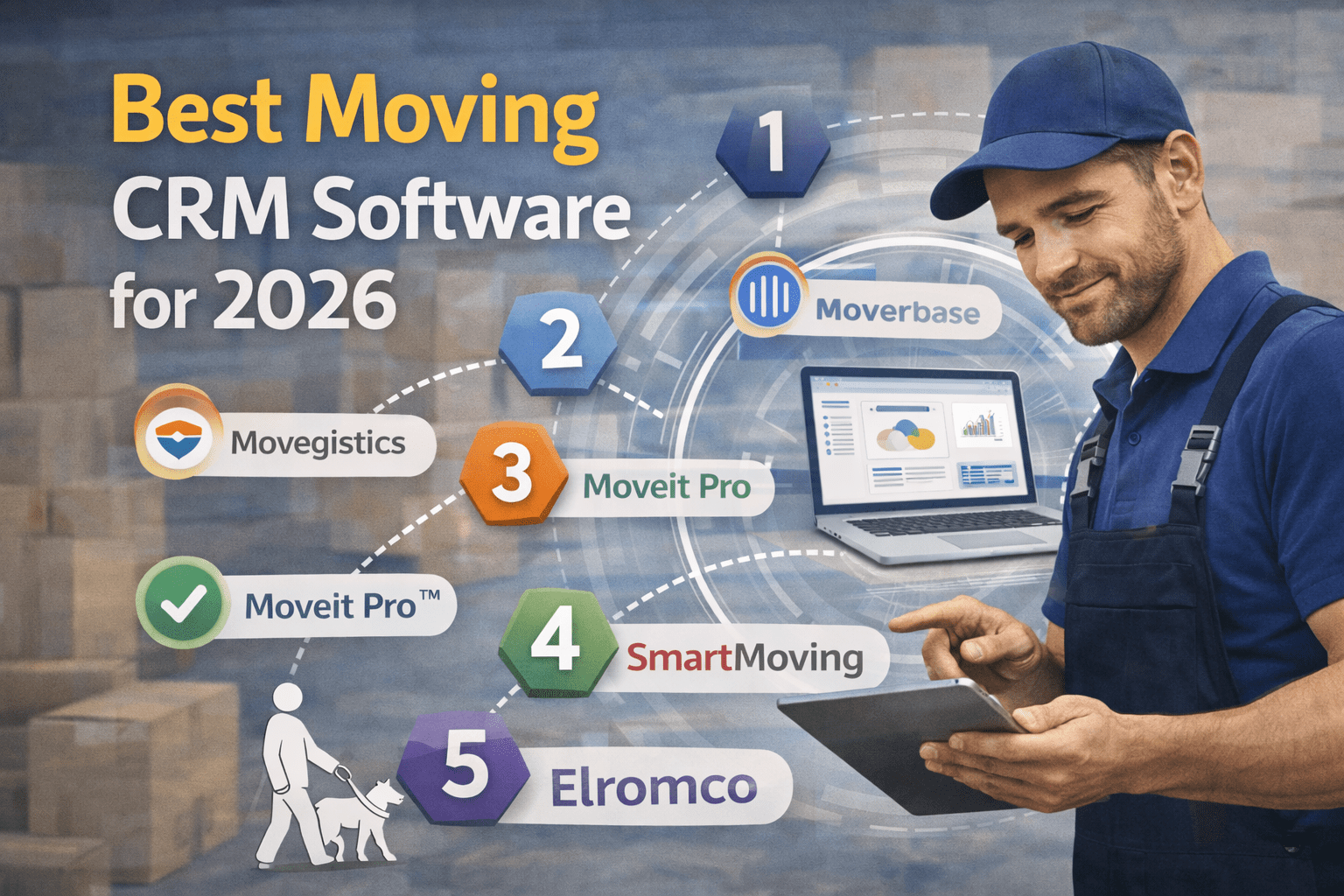
In this updated guide, Best Moving Leads Providers reviews the top 5 best moving CRM picks for 2026, including a 2025 recap and a 2026 outlook. You’ll see what’s changed over the past year, which platforms are refining their competitive edge, and how to choose the right CRM based on your company’s size, workflow, and growth goals.

What to Look For in the Best Moving CRM Software in 2026
Most moving companies already know the obvious CRM benefits— organized leads, cleaner scheduling, fewer dropped balls. But in 2026, the bar is higher. Modern CRMs are expected to reduce manual effort, improve operational accuracy, and keep teams aligned from the first call to the final invoice.
Here are the essential features to prioritize when evaluating moving CRM software:
Lead management and tracking
A moving CRM should capture leads from your website, phone calls, and third-party sources, assign them to team members, and track progress through the pipeline. The best systems include lead nurturing automation, task reminders, and structured stages so nothing gets lost during busy seasons.
Customer communication tools
Strong CRMs don’t just store contact info—they support ongoing communication. Look for built-in email and SMS tools, templates for common situations, and unified communication logs so your team always knows what’s been said and what’s pending. This becomes especially valuable when multiple team members interact with the same prospect or job.
Streamlined dispatching and crew scheduling
Dispatching is where many moving companies lose time and introduce avoidable errors. The best CRMs allow you to assign jobs, crews, trucks, and resources efficiently, while giving operations teams a clear daily view of what’s happening and when.
Claims and issue management
Claims are part of the moving industry. A quality CRM should support documentation, resolution tracking, internal notes, and customer updates—without forcing your team to chase paperwork across emails and folders.
Real-time dashboards and reporting
Live operational visibility matters. The best CRMs offer customizable dashboards, reporting, and performance snapshots that help you monitor lead response time, closing rates, job profitability, crew utilization, and day-to-day workload.
Integrated documents and e-signatures
Modern moving CRMs increasingly include built-in document workflows for estimates, contracts, bills of lading, and invoices. E-signatures reduce friction and speed up booking—especially when customers want a fast and easy “yes.”
Mobile access for crews and field teams
In 2026, a CRM that works only in the office is limiting. Crew tools, mobile surveys, and onsite updates improve accuracy and speed. If your teams work in the field (which they do), your CRM should support them there.
Integrations that reduce tool overload
More CRMs now integrate with Google Ads, Facebook, Mailchimp, review platforms, and payment tools. The goal is simple: fewer disconnected systems and less manual copying of data.
How We Ranked These CRM Platforms
To identify the top CRMs for movers heading into 2026, we used three criteria that matter most for real operations:
- Features – especially moving-specific functionality like dispatching, storage, claims, lead automation, and documentation.
- Cost & value – including pricing clarity and whether the platform scales reasonably as you grow.
- User-friendliness – because even the best features don’t matter if your team won’t use them consistently.
All five platforms below were strong contenders in the prior year’s analysis, and the list remains unchanged. What has changed is how each CRM evolved during 2025—pricing models, automation upgrades, and product direction—shaping what they look like as we head into 2026.

1) MoversTech
Best for: Movers who want flexibility, customization, and scalable operations without being forced into rigid workflows.
MoversTech continues to stand out in 2026 by improving the operational workflows moving companies rely on daily. Built specifically for the moving industry, it focuses on giving businesses more control over how the system fits their processes—without forcing standardized methods that don’t match real-world operations.
The platform maintains a clean, intuitive interface while offering configurability often found in more enterprise-grade systems. That balance makes it a strong fit for companies that want simple workflows today and advanced structure later—especially if you plan to expand into multi-branch operations and don’t want to migrate CRMs down the road.
One consistent differentiator: predictable, transparent pricing and an approach that avoids pressuring companies into forced upgrades or long-term lock-in.
2026 Outlook & 2025 Recap
During 2025, MoversTech invested heavily in the areas that directly affect daily execution and billing accuracy:
- Expanded billing logic and automation for real moving scenarios, including flexible extra charges, adjustable storage billing dates, and consistent labor rounding.
- More workflow automation across sales, dispatch, and billing—helping teams reduce repetitive tasks and keep handoffs consistent as volume increases.
- Stronger customization support, including improved use of custom fields across contracts, emails, and integrations.
- Better operational visibility, with clearer day views, flexible arrival windows, and a unified SMS/email inbox tied to jobs.
- Refined payment workflows, including automatic receipts, clearer invoice histories, and expanded ACH support for companies using its built-in processing.
- Maturing storage management, supporting structured handling of short-term and long-term storage across warehouses, zones, and containers—while keeping billing centralized.
Overall, MoversTech’s direction is clear: operational depth that scales when needed, without adding complexity just for the sake of it.
2) Elromco
Best for: Moving companies that want a feature-rich, all-in-one system and are comfortable with a higher monthly investment.
Elromco remains a strong all-in-one option for moving companies that want a single platform for lead management, estimating, booking, dispatching, billing, and customer communication. It’s cloud-based and built to support both smaller teams and larger operations looking for centralized control.
One of its strongest areas continues to be communication. Elromco supports both internal coordination and customer-facing messaging, while also handling quotes, bills of lading, and payment processing in one place. For companies that want fewer tools and fewer handoffs between systems, this “everything in one platform” approach is a major advantage.
The tradeoff is price. Elromco is positioned as a higher-cost option, with pricing noted as starting around $259/month billed yearly.
2026 Outlook & 2025 Recap
Elromco made a notable shift in 2025 by moving away from flat-rate pricing and adopting a user-based pricing model. Instead of one price for everyone, the structure now scales by team size, using tiered plans (Starter, Professional, Enterprise). This change makes the platform more accessible for smaller teams while still supporting larger organizations.
Alongside pricing updates, the platform continued enhancing AI tools, dispatching functionality, storage workflows, and customer portals—strengthening its position as a comprehensive, feature-dense CRM for movers who want a centralized system.

3) Supermove
Best for: Movers who want modern communication workflows and automation at scale, especially as they grow.
Supermove is designed to make communication faster and cleaner—internally and with customers. Its real-time texting and email tools keep everyone aligned, while interaction logs help teams maintain context and provide better service. The platform supports message templates so your company can keep consistent tone and faster response times across sales and operations.
Beyond communication, Supermove includes lead capture tools, dispatch functionality, document management, and real-time reporting that helps teams make faster decisions based on live performance metrics.
A key note for buyers: Supermove does not publicly list pricing on its website, so you typically need to contact their team to get a quote and understand plan structure.
2026 Outlook & 2025 Recap
Supermove expanded its feature set throughout 2025, with a strong emphasis on automation and scalability. Notable upgrades included:
- Automated Booking tools designed to reduce manual back-and-forth and speed up conversions.
- AI Sales Copilot features such as automated follow-ups, call summaries, and workflow assistance—helping teams respond faster and avoid missed opportunities.
- Continued momentum and visibility within the moving and storage industry across the U.S. and Canada, reflecting active growth and adoption.
In 2026, Supermove remains a strong contender for movers who want to modernize operations and push communication and automation deeper into their process.
4) SmartMoving
Best for: Companies that need enterprise-ready operations, complex pricing rules, and end-to-end process control.
SmartMoving focuses on profitability and operational efficiency by connecting booking, dispatch, crew management, and reporting under one system. Customers can schedule services using real-time availability and pricing, while dispatchers gain tools that help assign crews and resources intelligently.
The platform also includes crew management features for scheduling, job assignment, and performance tracking. For companies that want a unified view from booking to payroll—and the operational discipline that comes with it—SmartMoving is built for that kind of control.
SmartMoving historically did not show pricing publicly, but that shifted in 2025 with more transparent plan options.
2026 Outlook & 2025 Recap
As of 2025, SmartMoving introduced two standard plans:
- Essential: $299/month
- Growth: $399/month
This increase in pricing transparency makes it easier for moving companies to evaluate fit before committing to sales calls.
During 2025, SmartMoving also expanded:
- Automation features to reduce manual work
- Reporting and business intelligence for stronger operational decision-making
- Integration capabilities through broader API support
Toward the end of 2025, SmartMoving announced the acquisition of Remedy Payments, strengthening its integrated payment processing and financial visibility across jobs. For companies that want a comprehensive, “enterprise-ready” platform and can support the cost, SmartMoving remains a top option heading into 2026.

5) Movegistics
Best for: Movers who prioritize mobile-first operations, automation, and a customer portal experience.
Movegistics by Netensity is built with strong mobile capabilities that support onsite execution and real-time updates in the field. Teams can access important job details and update information as moves progress, improving accuracy and reducing delays caused by missing information.
A standout feature is the self-service customer portal, which gives customers more visibility and control. Clients can manage key move-related functions, track progress, and access relevant details—reducing inbound calls while improving overall satisfaction.
Movegistics also includes invoicing tools and financial integrations that help speed up billing and keep job records clean.
2026 Outlook & 2025 Recap
Throughout 2025, Movegistics continued strengthening its platform with updates focused on:
- Workflow automation, including task reminders, lead follow-ups, and improved handoffs between sales, dispatch, and crews
- Refined mobile tools, including crew and survey updates that support faster job completion and better field data capture
- A shift in pricing, with plans starting at a higher entry point than earlier years, reflecting broader capability expansion
While it may no longer be the most budget-friendly option, Movegistics remains a strong fit for companies that need mobile access, automation, and customer-facing transparency—especially for higher-volume operations or complex workflows.
CRM Benefits From a Marketing and Lead Generation Perspective
A moving CRM isn’t only an operations tool—it can also support better marketing performance and higher conversion rates when used correctly. When your CRM is aligned with your marketing strategy, you’re not just collecting leads—you’re improving how leads get handled, nurtured, and converted.
Here’s how the right CRM strengthens growth:
Customer segmentation
A strong CRM helps you categorize customers based on move type, history, service preferences, seasonality, and feedback. This segmentation supports smarter follow-up and more relevant offers.
Targeted marketing campaigns
When you can segment properly, your campaigns become more precise. Email and SMS campaigns perform better when messaging matches what the customer actually needs.
A more personalized customer experience
From first inquiry through post-move follow-ups, CRMs help you deliver consistent communication and a smoother experience. That matters for reviews, referrals, and repeat business.
Data analytics for strategy optimization
The best CRMs help you track campaign performance and lead outcomes—so you can identify which marketing channels generate real booked jobs, not just inquiries.
Integrations with marketing tools
Many CRMs now connect with platforms like Google Ads, Facebook, Mailchimp, and review tools. When these systems communicate properly, you can attribute performance more accurately and reduce manual admin work.

Final Thoughts: Choose a CRM That Fits How Your Company Actually Works
CRM software for movers should do more than store contacts. The best moving CRMs streamline operations, reduce manual work, improve communication, and help you scale with fewer headaches. Whether you’re a small local mover or managing multiple crews across regions, the right platform helps you stay organized, respond faster, and improve customer experience, without forcing your team into workflows that don’t match reality.
With many meaningful improvements rolled out during 2025 and continued momentum heading into 2026, now is a strong time to review your options. Use this list as a starting point, compare features against your actual workflow, and prioritize adoption, because even the best CRM won’t help if your team doesn’t use it daily.
If your goal is growth in 2026, your CRM should support that growth by keeping leads organized, operations efficient, and customer experience consistently strong