Why Moving Companies Need an After-Hours Answering Strategy (And How to Build One)
Every moving company invests significant time, energy, and money into generating leads. Search ads, SEO, social campaigns, referral programs, and paid lead providers all work to keep the phone ringing. Yet a surprising number of those carefully generated leads quietly evaporate every single week — not because the marketing failed, but because the phone rang at 7 PM, 9 PM, or on a Saturday afternoon when nobody was there to answer. The customer got a voicemail greeting, hung up, and dialed the next mover on their list.
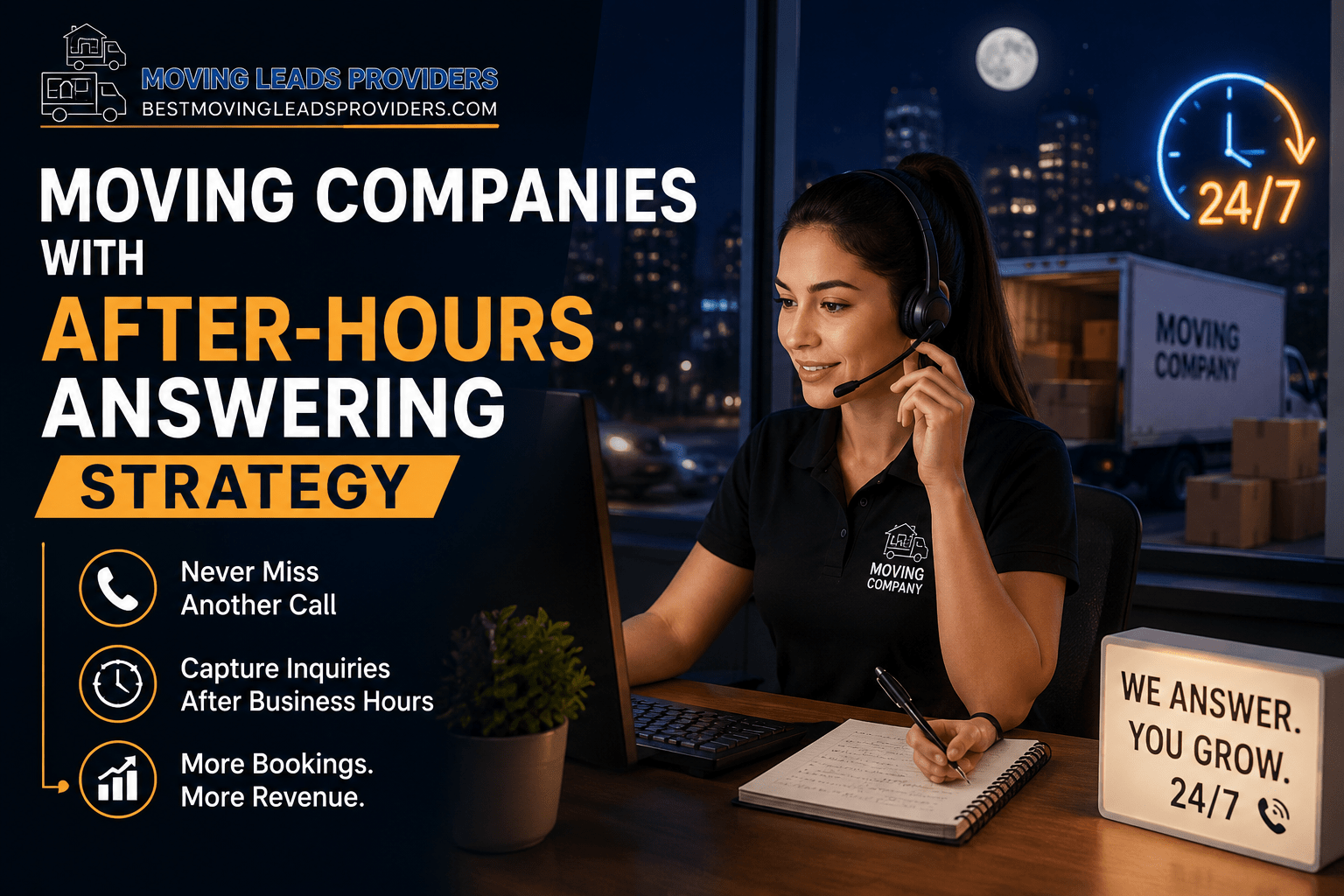
At Best Moving Leads Providers, we deliver exclusive, shared, and live transfer leads to moving companies across the country, and the single biggest factor separating high-converting clients from struggling ones is whether they answer their phones around the clock. After-hours answering is no longer a luxury for movers — it has become a fundamental part of protecting the lead investment and capturing the booked-move revenue that voicemail otherwise destroys. This article explains why the after-hours window matters so much, what your options are, and how to build a system that keeps your business earning even when your office lights are off.
Why Voicemail Has Become a Revenue Killer
Customer behavior has fundamentally changed in the last decade. When someone is preparing for a move — searching online, comparing companies, requesting quotes — they expect immediate responses. They have a phone in their hand, a search results page open in their browser, and three or four moving company numbers in front of them. The first company that actually answers and sounds professional wins the conversation. The ones that pick up after the second or third call almost never get a callback.
The painful reality is that most after-hours callers will not leave a voicemail. They will simply hang up, click the next listing, and book with whoever answers. Every missed evening call is essentially a lead handed directly to a competitor.
For movers who purchase leads, this is even more damaging. You have already paid for that prospect to call your business. When the phone rings at 8 PM and goes to voicemail, you are not just losing a potential booking — you are losing the money invested to generate the lead in the first place. The economics of lead generation simply do not work when half the leads land in voicemail.

The Real Financial Picture of Missed Calls
Let’s run a simple, illustrative example. Imagine your average residential move is worth around twelve hundred dollars in revenue. If your business misses four calls per week during evenings and weekends — a conservative estimate for many local movers — and even one in four of those callers would have booked, you are losing roughly twelve hundred dollars a week in unrealized revenue. Over a year, that single missed booking per week adds up to more than sixty thousand dollars in lost income. For long-distance and commercial movers with higher average job values, the number climbs dramatically higher.
Now layer in peak season, when call volume spikes and your team is stretched thin. The very weeks when after-hours calls are most valuable are the same weeks when voicemail catches the most of them. Movers without an after-hours strategy effectively cap their own growth at the busiest moments of the year.
The Three Main Types of After-Hours Answering Solutions
There is no single right answer for every moving company, but the solutions fall into three broad categories, each with distinct strengths and limitations.
Traditional live answering services use human operators in a call center who answer your phone according to a basic script, gather caller information, and pass the message along for follow-up the next business day. This approach is better than voicemail because at least the lead information is captured, but it remains fundamentally reactive. The customer still has to wait until the next day for an actual quote, and by then they have usually called several other companies and booked with one of them. For low-value or non-urgent calls, this can be acceptable. For high-intent moving leads, the delay is often fatal.
Virtual receptionists are a more polished evolution of the same idea. Instead of a generic operator, you get a dedicated person or small team who learns your business, accesses your scheduling system, and handles calls with more familiarity. They can answer basic questions, check calendar availability, and sometimes schedule appointments. The challenge with virtual receptionists is cost and scalability — providing genuine twenty-four-seven coverage with trained humans becomes expensive, and a single receptionist can be quickly overwhelmed during busy seasons.
AI-powered answering systems represent the newest category, and they are reshaping how moving companies handle calls. Modern conversational AI tools trained for the moving industry can answer every call instantly, ask the right qualifying questions, deliver accurate quotes based on your pricing rules, and book the job directly into your calendar — all without human involvement. They scale without limit, run around the clock, and typically cost a fraction of staffed alternatives. The trade-off is that AI tools require careful setup and ongoing tuning to match the nuance of your specific operation.
What to Look For in Any Answering Solution
Whichever category you choose, certain features separate effective after-hours answering from glorified voicemail.
The first is real-time visibility into your schedule. An answering service that cannot see your dispatch calendar can only take messages — it cannot actually book jobs. True calendar integration lets the system check availability, hold time slots, and confirm bookings instantly, eliminating the double-bookings and morning callback chaos that frustrate customers.
The second is accurate, immediate quoting capability. Telling a caller that someone will get back to them tomorrow with a price is one of the fastest ways to lose them. Your answering solution should be able to generate accurate quotes on the call using your real pricing — hourly rates, flat-rate calculations, travel time, additional services, and surcharges for stairs, long carries, or specialty items. Customers who get an instant quote on the phone book at dramatically higher rates than those promised a callback.
The third is thorough lead intake. Just gathering a name and phone number is not enough. The system should collect pickup and destination addresses, home types, move size, access challenges like stairs or elevators, special items, and preferred dates. The depth of the intake reflects the professionalism of the company and produces the information needed to quote accurately.
The fourth is automated follow-up. Once a booking is captured, the system should immediately send a confirmation text or email summarizing the appointment, providing your contact details, and reassuring the customer that everything is set. This single touch dramatically reduces no-shows and cancellations while reinforcing the customer’s confidence in your business.
The ROI Conversation Is Simpler Than It Looks
The mathematics of after-hours answering services almost always works out in the mover’s favor. Most modern solutions cost a few hundred dollars per month — sometimes less for AI-based systems. If that service captures even a single booked job per month that would otherwise have been lost to voicemail, it has paid for itself several times over. Every booking beyond that flows directly to the bottom line.
Beyond the hard revenue numbers, there is also the value of operational peace of mind. Owners and managers who know their phone is being answered professionally around the clock can actually disconnect at the end of the day, instead of constantly checking voicemails during family time. That mental relief alone is worth more than the monthly subscription for most movers.
Pairing Answering Services With Strong Lead Quality
After-hours answering systems work best when they sit on top of a steady flow of high-quality leads. There is little point in answering every call promptly if the leads themselves are poor. This is why our team at Best Moving Leads Providers focuses on delivering exclusive, shared, and live transfer leads that match your service offerings, geography, and conversion strengths — leads that arrive ready to convert, especially when paired with a professional after-hours answering strategy. Combined with our digital marketing services, including SEO, PPC, and online reputation management, this creates a complete system that protects every lead from the moment it is generated to the moment the booking is confirmed.
Frequently Asked Questions
Can an AI answering system really handle moving-specific questions accurately? Modern AI tools designed for the moving industry are trained to ask the same qualifying questions an experienced dispatcher would. They handle inventory details, stairs, long carries, specialty items, and pricing rules with consistent accuracy when properly configured.
Will customers be frustrated talking to an automated system? Most callers prioritize speed and a clear answer over the format of the conversation. An AI that solves their problem in two minutes consistently outperforms a human who promises to call back tomorrow.
Is after-hours answering affordable for small moving companies? Yes. Most modern services scale to small operators, and even a single recovered booking per month typically pays for the service many times over.
Can I use an answering service alongside my own team during business hours? Absolutely. Most movers route after-hours and overflow calls to their answering service while handling primary business hours in-house. This hybrid approach is usually the most efficient.
Every missed call after hours is a paid lead lost and a competitor’s business gained. Moving companies serious about growth treat after-hours answering as essential infrastructure, not optional overhead. With the right answering strategy paired with high-quality leads from Best Moving Leads Providers, your business can capture revenue around the clock and turn voicemail from a silent profit-killer into a non-issue.