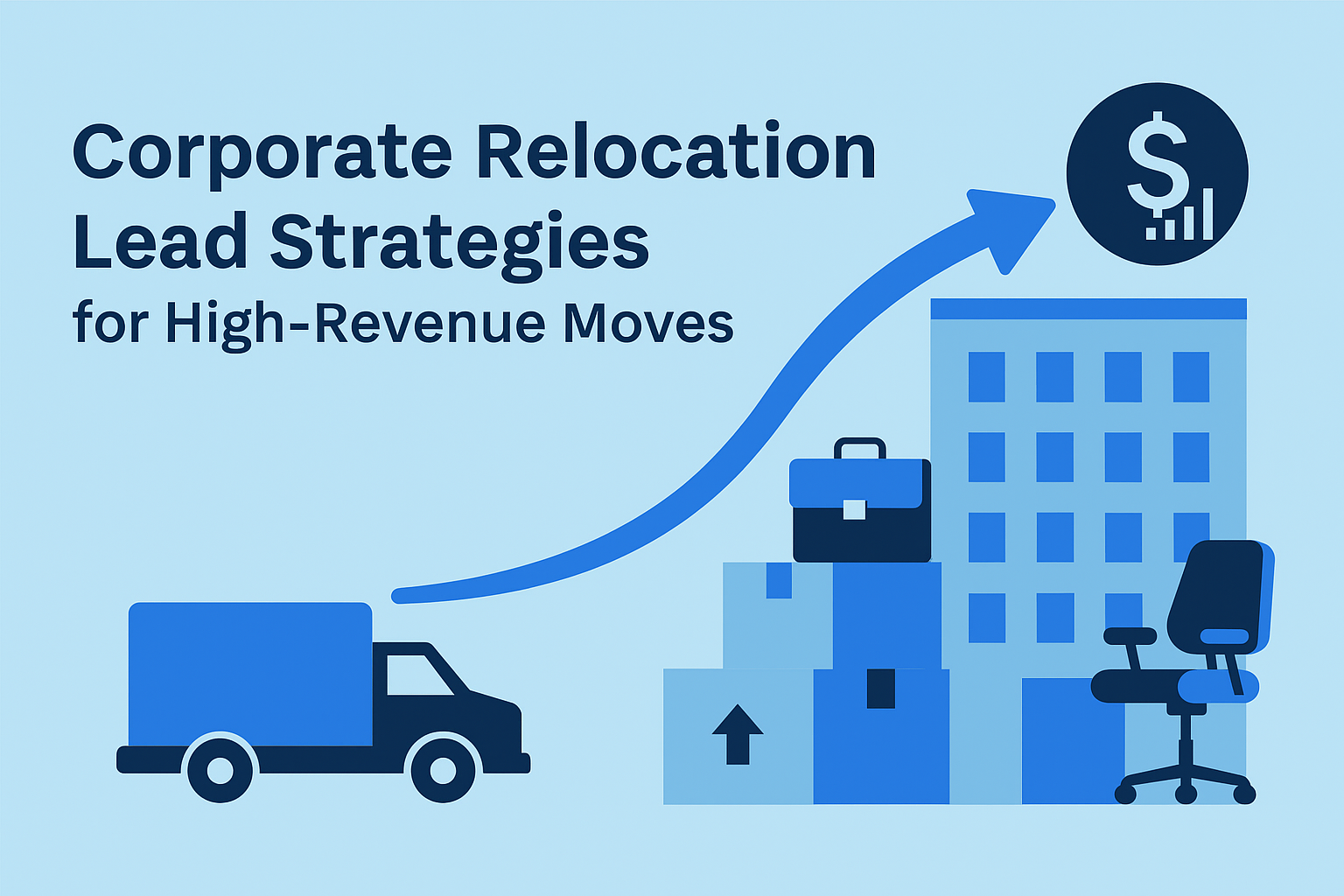
Corporate Relocation Lead Strategies for High-Revenue Moves
Corporate relocation is one of the most lucrative niches in the moving industry. While local residential moves often bring in quick jobs with modest margins, corporate relocations can generate high-value, long-term contracts. These moves not only involve higher ticket sizes but also recurring opportunities—since businesses relocate offices, warehouses, and teams periodically.
For moving companies ready to scale beyond residential jobs, winning corporate relocation leads requires a refined strategy. Let’s dive into proven approaches that can help you attract, convert, and retain high-revenue corporate clients.
Why Corporate Relocation Leads Are Different
Before building strategies, it’s crucial to understand what sets corporate relocation apart:
- Higher deal size: Office and corporate relocations can range from tens of thousands to hundreds of thousands of dollars.
- Decision-makers: Instead of dealing with individual homeowners, you’ll interact with office managers, HR directors, CFOs, or relocation specialists.
- Complexity: Corporate moves often require specialized services—IT equipment relocation, furniture deinstallation/reinstallation, storage, and coordination with building management.
- Recurring potential: Many businesses expand or downsize regularly, creating opportunities for ongoing partnerships.

Strategy 1: Build Relationships with Decision-Makers
Unlike residential moves driven by online search or lead providers, corporate relocations often depend on trust and reputation.
- Identify target roles: Facilities managers, HR directors, procurement officers, and CEOs of mid-sized businesses.
- LinkedIn prospecting: Use LinkedIn Sales Navigator to build a list of local businesses with 50–500 employees. Reach out with value-driven messages offering relocation planning resources.
- Networking events: Join local chambers of commerce, B2B networking groups, or real estate associations where corporate decision-makers gather.
- Account-based outreach: Focus on fewer but high-value targets, sending personalized proposals rather than generic emails.
Strategy 2: Partner with Commercial Real Estate Brokers
Commercial brokers are the gatekeepers of office relocations. When a company leases or buys new space, a move is inevitable.
- Position yourself as a problem-solver: Offer brokers co-branded relocation guides or checklists they can give to clients.
- Create referral agreements: Some brokers are open to partnerships where you handle their clients’ moving needs while making them look good.
- Attend property tours & networking mixers: These are prime opportunities to meet decision-makers at the exact moment they’re planning a move.

Strategy 3: Develop Specialized Corporate Relocation Services
Businesses don’t want “just movers.” They want relocation partners who understand the challenges of office transitions.
- IT and electronics handling: Provide specialized packing and setup for servers, computers, and telecommunications.
- Office furniture solutions: Offer deinstallation, reassembly, and space planning for modular workstations.
- Employee relocation: Bundle services for transferring staff households when companies relocate employees across cities or states.
- After-hours/weekend moves: Flexibility is a selling point—companies can’t afford major downtime.
When you showcase these specialized services, you position your company as more than a mover—you become a corporate relocation partner.
Strategy 4: Create Corporate Relocation Packages
Businesses love clarity and predictability. Instead of vague quotes, present structured packages that simplify decision-making.
- Basic Package: Office furniture moving, standard packing/unpacking, local transport.
- Professional Package: IT relocation, document management, storage solutions, insurance.
- Enterprise Package: End-to-end project management, employee relocation, international logistics, post-move setup.
Tiered packages help clients self-select based on budget and needs while showing your flexibility.

Strategy 5: Use Case Studies and Testimonials as Proof
Corporate decision-makers need assurance that you can handle large-scale moves.
- Case studies: Document past corporate moves—highlight the number of employees relocated, time saved, and challenges solved.
- Video testimonials: A facilities manager or CEO endorsing your company is more powerful than a simple review.
- Before-and-after visuals: Showcase how you transformed an office move with minimal disruption.
Social proof builds the trust necessary for securing high-revenue contracts.
Strategy 6: Invest in Thought Leadership Content
Corporate relocation leads often start with research. By publishing content tailored to businesses, you establish authority and attract inbound opportunities.
Content ideas include:
- “Corporate Relocation Checklist for Office Managers”
- “How to Minimize Downtime During an Office Move”
- “The Complete Guide to Employee Relocation Programs”
- “Budgeting for Corporate Relocation: Costs to Expect”
Host these on your blog, promote them on LinkedIn, and create downloadable resources (like whitepapers or checklists) to capture leads.

Strategy 7: Optimize for Corporate Relocation SEO
Your website should clearly signal that you handle large, corporate jobs—not just residential moves.
- Dedicated corporate relocation page: Highlight services, packages, and case studies.
- Target B2B keywords: “corporate relocation services,” “office moving company,” “business relocation movers,” “employee relocation program.”
- City + service targeting: “Corporate relocation services in [City],” “Office movers near me.”
- Landing pages: Build location-specific service pages for major business hubs where you operate.
Strong SEO ensures you appear when companies search for relocation partners.
Strategy 8: Offer Project Management Support
One of the biggest headaches in corporate moves is project coordination. Stand out by offering dedicated project managers.
- Pre-move planning sessions with key stakeholders.
- Timeline creation to minimize business disruption.
- Building coordination (permits, elevator reservations, parking logistics).
- Post-move checklists to ensure employees can start work immediately.
When businesses see that you handle logistics beyond the physical move, you become indispensable.

Strategy 9: Leverage Strategic Partnerships
Beyond real estate brokers, there are multiple industries you can partner with for a steady pipeline of leads:
- Office furniture suppliers & installers
- IT service providers & managed service companies
- Interior designers specializing in office spaces
- Property management firms
These partners often get involved early in relocation planning and can refer your services as part of a complete solution.
Strategy 10: Create Retainer and Long-Term Contracts
Instead of chasing one-off corporate jobs, design ongoing partnership models.
- Retainer contracts: Offer companies priority scheduling, reduced rates, or bundled services for multiple moves per year.
- Multi-year agreements: Large corporations often relocate teams regularly—locking them in ensures predictable revenue.
- Facility services partnerships: Expand beyond moving—offer storage, logistics, disposal, or office setup services.
The more integrated you are into a company’s operational cycle, the harder it becomes for them to switch providers.

Strategy 11: Attend Corporate Relocation & HR Conferences
Industry events are prime places to network with relocation professionals, HR managers, and corporate service providers.
Examples include:
- Corporate Relocation Council events
- HR-focused conferences (SHRM, WorldatWork)
- International relocation summits
These gatherings put you directly in front of high-value decision-makers while positioning you as a serious player.
Strategy 12: Focus on Employee Experience
Remember: corporate moves aren’t just about office furniture—they impact employees directly. Companies care deeply about minimizing disruption for their teams.
- Welcome kits: Provide employees with packing guides, moving tips, or boxes labeled by department.
- White-glove service: Offer personal relocation packages for executives or managers.
- Communication tools: Give employees a dedicated hotline or portal to ask questions.
When employees have a seamless move, the company sees you as a valuable partner for future relocations.

Wrapping Up
Corporate relocation leads represent the pinnacle of opportunity in the moving industry: higher revenues, recurring contracts, and deeper partnerships. But they require a specialized approach.
To succeed, focus on:
- Building strong relationships with decision-makers and partners.
- Showcasing expertise through tailored services, case studies, and content.
- Offering end-to-end project management and employee-centric solutions.
- Positioning yourself not just as movers, but as corporate relocation consultants.
By combining outreach, partnerships, specialized services, and thought leadership, you can establish a steady pipeline of high-revenue corporate relocation leads and scale your moving business to the next level.