How to Locally Rank Your Moving Company for Multiple Cities
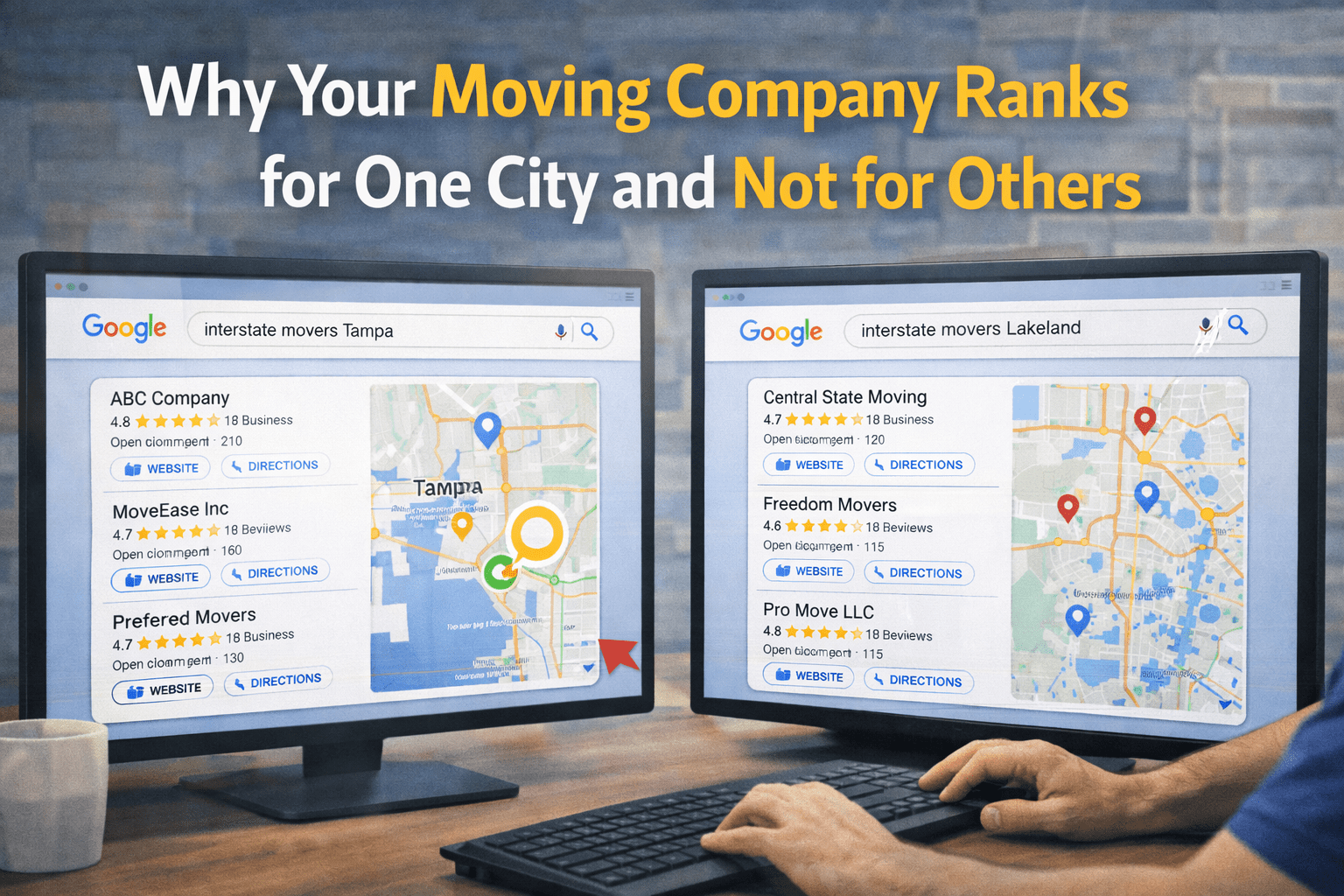
You search your moving company on Google and notice something frustrating. You rank well in one city, yet just a few miles away your visibility drops sharply. The same website, the same crews, and the same services, but very different results. This is one of the most common challenges movers face with local SEO.
Google does not treat nearby cities as one shared market. Instead, it evaluates your moving company city by city, using different local signals for each area. That is why a moving company ranks in one city but not another, even when nothing obvious appears to change. The good news is that this problem is rarely permanent. Once you understand how local rankings work and which signals matter most, you can fix the gaps and expand your reach across multiple cities.
At Best Moving Leads Providers, we help movers identify those signals and turn them into practical steps that improve city-level rankings and lead flow.
How Google Thinks About Local Rankings
Google evaluates your business separately for every city you target. Each location becomes its own ranking test. Instead of assuming your company serves an entire metro area equally, Google looks for proof that you are relevant to each specific city.
Local rankings depend on three main factors: relevance, distance, and prominence. Relevance comes from how well your website and listings match searches in a city. Distance is measured from the searcher to your business location. Prominence is based on reviews, citations, and overall authority.
Organic results and map results also work differently. Organic listings rely more on website strength, content quality, and backlinks. The local map pack depends heavily on proximity, reviews, and Google Business Profile activity. Understanding this difference explains why a moving company ranks in one city but not another, even when the same website is used everywhere.
Why Your Moving Company Ranks in One City but Not Another
Ranking gaps usually follow clear patterns. Once you know what to look for, the issue becomes easier to diagnose and fix.
Location Pages Are Missing or Too Generic
Many movers rely on one general service area page to cover multiple cities. Google expects stronger signals. If a city page only mentions the city name once or repeats the same text across multiple pages, it fails to stand out.
Strong city pages explain how your services apply locally. They mention neighborhoods, local move types, service boundaries, and common customer needs in that area. Pages built with a clear structure, similar to high-converting landing pages, tend to rank and convert better. Without this depth, Google has little reason to rank your company in that city.
Proximity and Address Signals Matter More Than You Think
Distance plays a larger role in local rankings than many movers expect. Google prefers businesses that feel physically close to the searcher. That is why rankings often improve near your office and weaken farther away.
You cannot change where your office is located, but you can strengthen how clearly that location is defined online. Consistent address details across your website, directories, and Google Business Profile help Google trust your location signals. When those signals are clear, rankings improve in cities where proximity already works in your favor.
Reviews Are Strong in One Area and Weak in Another
Reviews influence rankings far beyond trust and credibility. Google looks at review content to understand where your company operates. When customers mention specific cities, neighborhoods, or landmarks, those details tie your business to that location.
This is why a moving company ranks in one city but not another, even with a similar number of reviews overall. Recent reviews matter more than older ones. If most new feedback mentions one city, that area gains ranking strength while others lag behind. Encouraging reviews from customers across all service areas helps balance visibility.
Inconsistent Business Information Across Cities
Consistency is critical for local SEO. Google compares your name, address, and phone number across hundreds of sources. When details differ—even slightly—Google becomes less confident in where you belong.
Old addresses, outdated phone numbers, mismatched categories, or incomplete listings can all weaken city-level rankings. These issues often accumulate over time as businesses expand. This inconsistency is one of the most common reasons a moving company ranks in one city but not another. Once listings are cleaned up and standardized, rankings tend to stabilize and improve.

Local Competition Changes From City to City
Every city has a different competitive landscape. Some areas have only a few movers with limited online presence. Others are crowded with established companies that invest heavily in SEO, reviews, and ads.
Google compares your business against competitors in that specific city, not across your entire region. Even if your setup stays the same, rankings can drop in more competitive markets. Studying who already ranks in a city and how strong their online presence is helps set realistic expectations and priorities.
Your Google Business Profile Is Doing the Heavy Lifting
Your Google Business Profile often determines how far your visibility extends. Categories, service areas, photos, posts, and updates all influence how Google connects your business to specific cities.
Broad or poorly defined service areas weaken location signals. Infrequent updates reduce engagement. When your profile sends mixed messages, Google limits reach. This is another reason a moving company ranks in one city but not another. Clear service areas, regular activity, and accurate categories help strengthen visibility across multiple cities.
Why Guessing Does Not Work in Local SEO
Many movers try to fix ranking gaps by guessing. They assume the issue is competition, timing, or algorithm changes. Without city-level data, effort goes into the wrong fixes. This is why a moving company ranks in one city but not another often remains unresolved for months.
Local SEO requires precision. Each city must be evaluated on its own. When you rely on assumptions instead of data, time and budget are wasted while rankings stay uneven.
How a Local SEO Audit Finds the Real Problem
A local SEO audit reviews performance city by city instead of treating your service area as one market. It examines location pages, business listings, review patterns, and Google Business Profile signals for each city.
The audit checks whether city pages provide strong local relevance. It looks for inconsistencies in business information across directories. It evaluates how reviews support or weaken visibility in specific areas. When all signals are reviewed together, patterns emerge.
This process clearly explains why a moving company ranks in one city but not another and shows exactly what needs to be fixed first.
Review Your City Rankings and Fix the Gaps
When a moving company ranks in one city but not another, the cause is never random. Google reacts to city-specific signals, and those signals can be strengthened. Once you identify what holds each city back, your next steps become focused and effective.
At Best Moving Leads Providers, we help movers uncover these gaps and prioritize fixes that lead to measurable improvements. A local SEO audit brings clarity, reduces wasted effort, and helps your company expand visibility across multiple cities. When you understand how Google views each location, ranking across your entire service area becomes achievable.