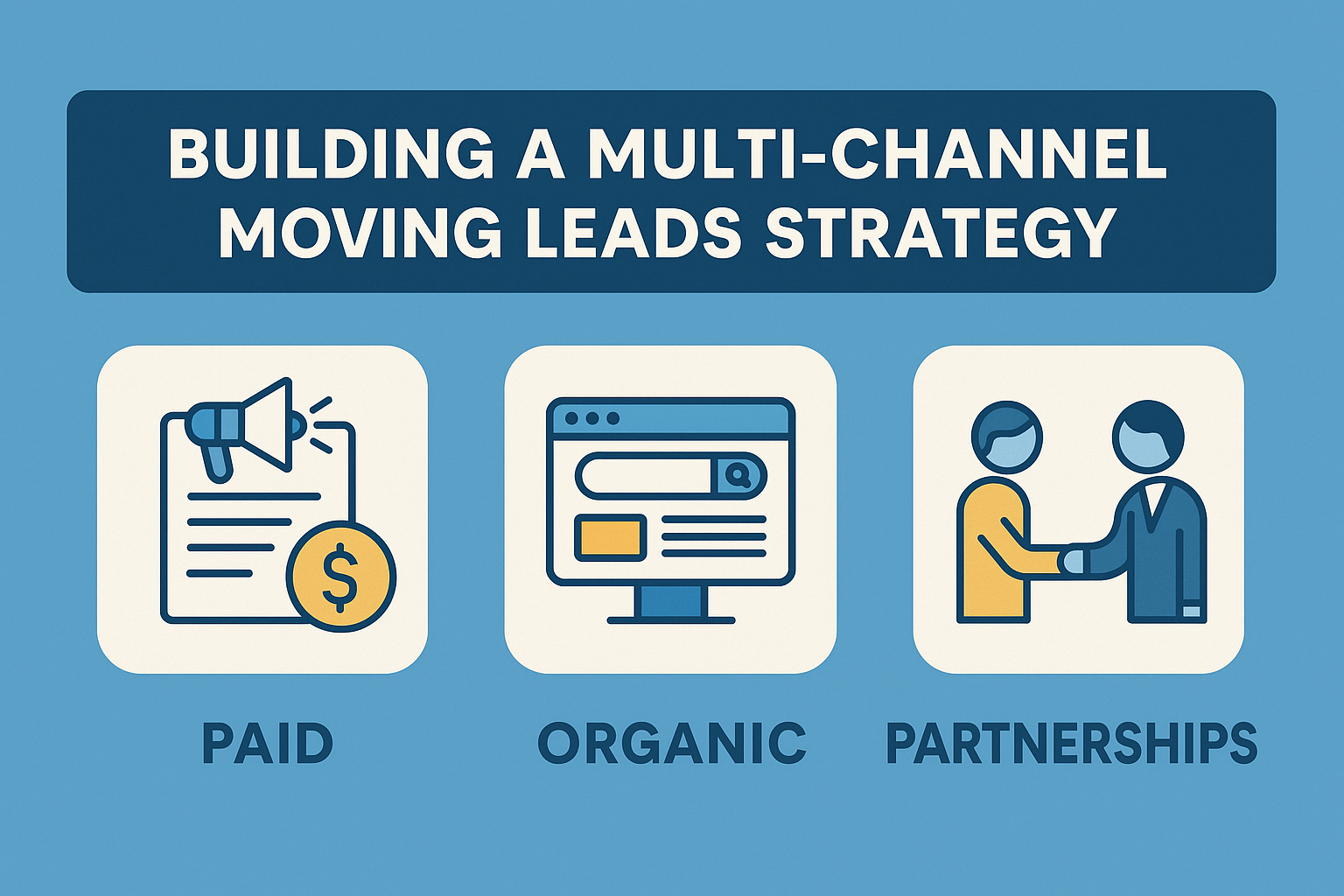
Building a Multi-Channel Moving Leads Strategy: Combining Paid, Organic, and Partnerships
The moving industry is more competitive than ever, and relying on a single source of leads can put your business at risk. Whether you depend only on paid ads, third-party lead providers, or referrals, the truth is that no single channel can guarantee consistent growth. That’s why the most successful moving companies build a multi-channel lead generation strategy that blends paid, organic, and partnership-based approaches.
This combination not only ensures a steady flow of new prospects but also helps movers lower risk, reduce acquisition costs, and create long-term sustainability. In this guide, we’ll break down how movers can use each channel effectively and why the real power comes from combining them into one system.

Why a Multi-Channel Strategy Matters
Putting all your energy into one source of leads may seem easier, but it creates vulnerabilities:
- Paid ads become expensive if competition increases.
- Organic search engine rankings take time to build and can fluctuate.
- Partnerships may dry up if relationships change.
By diversifying, movers can:
- Maintain consistent job bookings even when one channel slows down.
- Improve brand awareness across multiple platforms.
- Build resilience against market changes and competitor activity.
Think of it like investing — you wouldn’t put all your money into one stock. Likewise, you shouldn’t rely on one source of moving leads.
Paid Leads: Fast Results, Higher Costs
Paid lead generation gives movers immediate access to people actively searching for moving services. It includes both buying leads from providers and running digital ad campaigns.
Benefits of Paid Leads:
- Instant Traffic and Leads – No waiting for months like with SEO.
- Scalable – You can increase or decrease spend based on demand.
- Targeted – Ads can be shown to specific demographics or locations.
Drawbacks:
- High cost per lead, especially in competitive cities.
- Risk of wasted spend if campaigns aren’t optimized.
- Dependency on budget — when spending stops, so do leads.
Best Practices:
- Test multiple paid sources (Google Ads, Facebook, lead providers).
- Track ROI closely using a CRM or analytics system.
- Use automation to respond instantly to paid leads.
Paid leads are excellent for quick growth and filling urgent job slots but should not be your only strategy.

Organic Leads: Long-Term and Cost-Efficient
Organic leads come from SEO, content marketing, local search listings, and online reviews. Unlike paid leads, you don’t pay per click or per lead — instead, you invest time and resources into building a strong online presence.
Benefits of Organic Leads:
- Lower Long-Term Costs – Once ranked, leads are essentially free.
- Trust and Authority – Customers trust companies that appear naturally in search results.
- Sustainability – SEO and reviews continue to generate leads even without ad spend.
Drawbacks:
- Takes time to see results (3–6 months or longer).
- Requires consistent effort in content creation and optimization.
- Competitors may try to outrank you.
Best Practices:
- Optimize your website for “movers near me” and city-specific keywords.
- Publish blog posts and guides that answer common moving questions.
- Actively collect and showcase online reviews.
Organic strategies are the foundation of long-term growth and brand authority.
Partnerships: Leveraging Relationships
Partnerships are often overlooked, but they can be one of the most powerful sources of high-quality leads for movers. These leads come from real estate agents, apartment complexes, storage facilities, and corporate relocation programs.
Benefits of Partnerships:
- Pre-Qualified Leads – Customers already need moving services.
- Lower Competition – Referrals often go directly to your company.
- Trust Factor – Recommendations from partners carry weight.
Drawbacks:
- Takes time to build and maintain relationships.
- May require revenue sharing or discounts.
- Not always scalable — limited to your local network.
Best Practices:
- Build referral agreements with realtors and property managers.
- Offer incentives to partners who consistently send you clients.
- Provide excellent service so referrals turn into repeat business.
Partnerships are best for high-quality, trust-based leads that often convert at higher rates.

How to Combine Paid, Organic, and Partnerships
The real magic happens when movers blend all three approaches into one cohesive system.
Example Strategy:
- Use Paid Leads to generate immediate bookings and keep trucks full.
- Invest in Organic SEO and Content to reduce reliance on ads over time.
- Develop Partnerships for a steady flow of pre-qualified, referral-based customers.
This mix ensures your business is never fully dependent on one source and allows you to scale more confidently.
Tracking and Measuring Success
A multi-channel strategy only works if you know what’s performing best. Movers should track leads from every channel to measure:
- Cost per lead and cost per booking by channel.
- Conversion rates (how many leads turn into jobs).
- Lifetime value of customers from each channel.
Using a CRM system makes it easier to tag leads by source and analyze which channels deliver the best ROI. Over time, this helps you adjust your budget and effort for maximum efficiency.

Final Thoughts
Relying on a single lead source is like building a house on one pillar — it won’t stand for long. Movers who want consistent growth must embrace a multi-channel strategy that combines the fast results of paid leads, the long-term sustainability of organic traffic, and the high-quality conversions of partnerships.
By diversifying and integrating these approaches, your moving company can build a resilient pipeline of leads that supports steady growth year after year.
The future of moving lead generation belongs to companies that don’t just chase volume — they build smart, balanced systems that prioritize quality, efficiency, and sustainability.